I am trying to start a new Bible study journey in Anytype, but I couldn’t figure out a smooth and non-cumbersome way to manage all the verses and notes.
Some materials and their study focus:
Verses
Cross reference e.g. multiple books mentioning the same scenario
Version comparison
Notes
So I have verse as the basic unit, which I want to redisplay and reference in multiple occasions, but in those occasions, I want to only show relevant information. For example,
During side-by-side comparison, I only want to see the selected (2) versions. - During interlinear comparison, I want to see all versions of the same verse.
During reading, I prefer the format of paragraph; but for referencing, being able to quote individual verse, or different combination of verses. Like what @kaylamillerdevrequested.
A note on a verse remarking the version differences might be stored at the VerseObject or a separate note, depending on the note-taking situation (e.g. reading vs sermon), but I still want to be able to see or query all relevant notes during devotion.
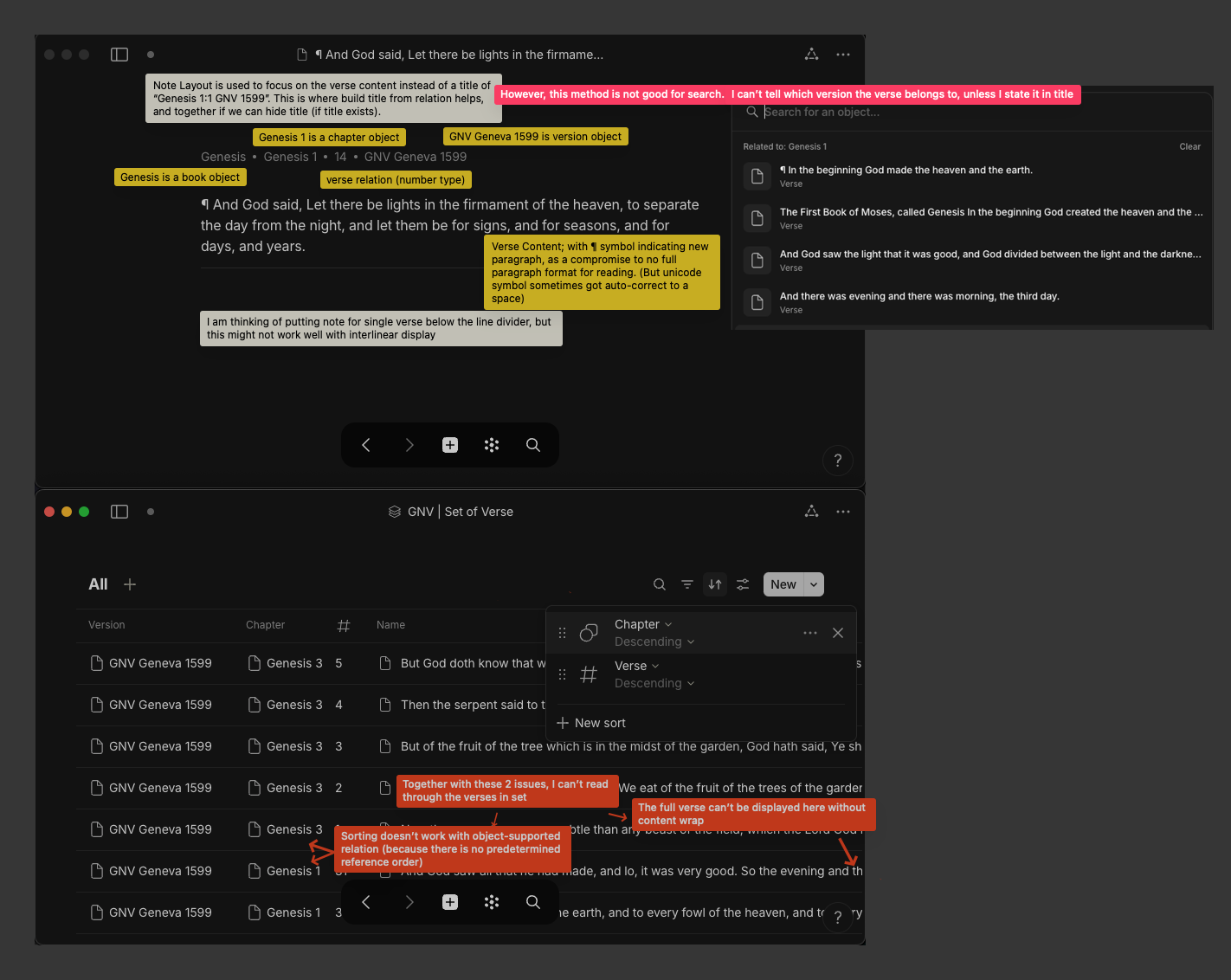
The effort to create objects for thousands of verses is a lot, and if I am to create, then re-apply template or batch change the live template relation, then that’s still lot more work.
Using self-referencing placeholder in template could help query or filter, but still I might need different combination of identifier/keys, and hence the workflow wouldn’t be as smooth as I would like.
The reason why I suggest the modular retrieval system of data is that template system works with one template at a time. I wouldn’t be able to display the same data in different format at the same time e.g. Verse in chapter format for reading on 1 tab/window, then interlinear on another tab/window.
Unless I use set/collection, but then for every verse, I need to create one set/collection for each note purpose: one set for verse in the chapter/book, one set for a verse for all its notes, one set for multiple versions of a verse
Hence, it seems to me a top-down data retrieval calling mechanism would be better than a bottom-up model for amending data display format which is constrained within the object.
Some existing features, feature requests or discussions:
Object-supported relation and @mention could allow linking but if notes are broken down to Verse level, it will take a lot of links. Eg. for John 1:1-14, it will take linking of 14 objects.
Giving Object Aliases would be a way to give John Ch.1 more names like John 1:1-14 and John 1:1-3. This is one way to actualise , but this method can mean a lot of aliases…
Transclusion and Blocks as objects would help quote verses within a chapter object. But if any single verse has to be quoted, it would still require users to break the paragraph into individual blocks (which is no different
Build title from relations so it is possible to simply call an object - John 1:1 with John being the BookObject, 1 being the ChapterObject or ChapterIdentifier, display colon :, then 1 being VerseIdentifier.
My money is on transclusion.
To your objection, you almost need to have ability to ‘highlight’ any text anywhere and turn that into a link Now wouldn’t that be something…
If they add transclusion, this could be the next step. Doing the highlight would automatically behind the scenes create a link to the block, and within the block make a child object on the highlighted text.
Not sure how much the devs will love this new headache and explosion of objects though
The ability to highlight any texts is probably an exaggeration to this use case, especially when users can already do so by @mention or links, or if we have Unlinked Mentions & Aliases for Objects.
This is more of a block based reference situation, which Transclusion could indeed be helpful, especially for referencing blocks on-demand. The use case focuses on referencing the same block multiple times, and there are regular systems/structure to what data should be displayed for the specific purpose.
Query might be the more relevant function. I believe with relational data model, which should be in place in Anytype already, this is not too difficult to implement in terms of data structure (but indeed would probably cause heavy impacts on UI).
This is how we can query or ask Anytype for different data. Every verse/note in this space contains candidate key (aka identifier) or a foreign key (to identify which verse it is linked to), then we can query objects that matches the candidate key (and other required filters) and display the relevant contents/relations in a FormatRelation (just like the live template relation concept).
However, as extended function to live template relation, with retrieval system, we can display multiple objects or multiple rows of data at the same time.
As an illustration, the following table shows what data field is required for what purpose.
Note-taking purpose
Book and/or Chapter (as identifier)
VerseNumber (as Identifier)
Version Identifer or Version Object
Note
Marking down the verse(s)
Must have
Must have for verse object use case (or semi-optional when storing each verse in a block within a chapter object)
Only when users plan to have multiple versions of the same verse (thus can be added later)
Not required but can be displayed if queried using the identifier from its note
Note on single verse
Must have
Must have
Only when needed
By definition (could be distinguished from object type or any assigned relation). This is a note
Note on a group of verses
Must have
Required multiple entries (to improve: allow inputting format like 1-10 and 1,2,5,6)
When needed
Same as above
Note on chapter/book
Must have
Not needed
Only when needed
Same as above
Note on location/people
Not required but would contain other information as identifier (e.g. John - the baptist vs John - the apostle)
Not required
Not required
Same as above
Interlinear comparison (from query)
Must have
Must have
Must have
When required. Note might be a co-relation between versions. e.g. Exist in KJV, but not in NIV
Side by side reading
Must have
Not required (unless change of purpose)
Require 2 or more
Same as above
The reason I did not emphasise on transclusion is that transclusion is mainly about aesthetic or the display of information. This use case
Then probably a batch query e.g. to read all verses in a chapter, query all objects with (ChapterIdentifier and not NoteObject), then sort by VerseNumber.
And then the aesthetic (e.g. display in set or display in an object).
However in an actual workflow, we probably want to pre-determine the aesthetic / FormatRelation (which gives Anytype information on what data to be displayed), then give Anytype instructions on what data to be queried.
P.S. I have no idea how the many Bible websites and applications work, but those should be useful reference. If we can do that in web2.0, we can definitely do that in web3.0.
P.S.2. @UnwokeNetizen Thanks for your insights. I can now better name the components of this use case (although might still be difficult for people to understanding… sorry
Side note: the functions mention here are useful for research as well. For example
Ask people to fill data in questionnaire (or form format) ← This must always be kept intact for data integrity.
Then ask Anytype to query participants (but don’t display ParticipantID for privacy reason)
Then redisplay quantitive data in set/collection, and calculate max/min to find out if there are extreme cases.
Then request and compare the qualitative texts side-by-side, to find out the special characteristics.
Super interesting, I’m working on building a Bible app that would integrate with an LLM for high quality semantic search and AnyType as the note taking feature. Not really sure how it would all work yet. I guess AnyType is still working on an API?
Your manual approach is interesting, I can see how powerful AnyType is but also how it’s a bit cumbersome for complicated data like this to do manually. I think there’s still a reason for dedicated bible study apps for this reason, but some kind of integration would be ideal.
API: according to the last town hall, team is already working on a Raycast extension api, so it might be coming soon. See API on GitHub roadmap for more information.
As for manual approach vs app, I definitely agree application would be the easiest approach for many. If you are planing to develop something, I believe many will support and show interests, and so will I.
One reason why I decide to go down the cumbersome route is that I plan to study less common books and versions, which resources are scattered all over different platforms and mediums. e.g. Apocrypha, which were included in the 81 books canonised in KJV 1611, in addition to the commonly used 66 books.
So if you are going to develop something, expansibility will be appreciated. Btw you might want to create a new feature request post with API and/or Plugins tags so more fellow members can discuss about it more specifically.
Hey thanks for the welcome and detailed reply! (Sorry I completely missed this)
I’m hesitant to self promote, but since you are interested, I would love for you to try my MVP, its on the app store. https://manuscript.faith
And actually, your use-case is exactly what I want to address, those who are curious enough to read obscure translations, compare different commentaries or historical books, look at books in the apocrypha or outside the canon. I think all of this is good for study.
I think the more we understand the intellectual and cultural context in which the original text was written, the more spiritual insights we actually gain. I’m trying to bring that scholarly context to even the most casual reader, while also satisfying pro readers like yourself.
I’m still working on my core features, but let me think about what the feature request would be for AnyType specifically, I think this is brilliant software and want to support its growth.
Do you know, does AnyType support the “network of objects” way of thinking that capacities does? I like the tech of AnyType, but Capacities seems to promote its value proposition more clear to me. https://capacities.io/compare/capacities-vs-notion
No problem at all. I will try your app and ponder how it might be incorporated to a workflow with Anytype, when I have time.. (Sorry, quite busy these days, so this might not be soon). Always support any thing that create insights, especially for beliefs and faith.
On network of objects, I haven’t used capacities before, so I can’t be sure. However, on brief note, Anytype also doesn’t have folder and rely on relation to gather objects together. Anytype has graph view which you can definitely link objects together as network.
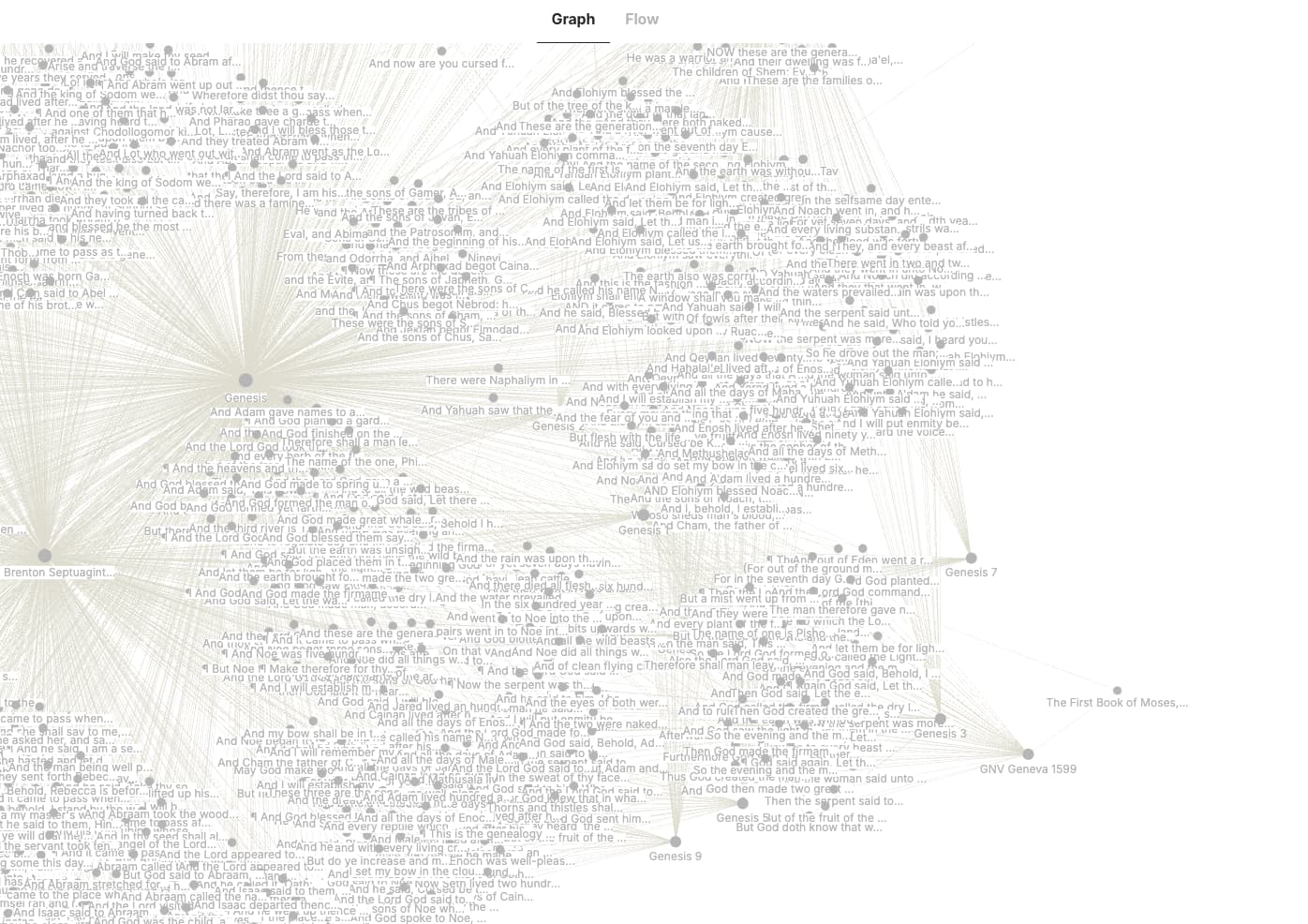
So far, this is what I have on my graph for the objects for my Scripture study, mainly on Genesis, which is quite hard to read and is pretty unstructured.. and note layout with verse content being the name isn’t serving me well in graph. Ideally, even if I link Book object as well Chapter object (as a verse object’s identifier), the graph could show Genesis followed by Genesis 1, 2 etc., instead of equal strength or distance between Genesis and Genesis 1,
I love this thread!
I too would like to use AnyType for study of the scriptures.
this is exactly what I was trying to figure out. I wanted to be able to quote the scriptures or chapters as references and links.
I have been even studying the the Dead Sea Scrolls and would love to have those connected as well.
I like to journal every day and connect the scriptures with that.
this is also why i really wanted the handwritten feature added also so i can write with my iPad.
Also, would like to have the greek and Hebrew definitions of the Scriptures so you can go deeper into the study of the words and there meanings.
There are so many connections that can be made. You could add locations or places, cities and topics. being able to create list of different events. I would love to have a list of all the battles the Israelites had.
 Now wouldn’t that be something…