Is your feature request related to a problem? Please describe.
I have certain projects that reoccur on a regular basis and would like to create a template for it. To manage progress in the project, I would like to create some pre-defined tasks alongside the project every time I create a new copy from the template for a project. Right now creating objects in a template makes them their own objects outside of the template.
Describe the solution you’d like
I would like to create a template for a certain type (e.g. a project) that has some pre-defined other objects in it (e.g. some tasks that always occur in a project of this kind).
When I create a new project from the template, I would like to have a set of tasks created along with it.
If you will, I would like to embed a template in another template and have the whole group of objects created when I create a new object from the higher-level template.
Describe alternatives you’ve considered
A workaround right now is to add a text list of “tasks to be created” in the project template, but I would prefer this process to be automated.
An alternative is to create a list of tasks as checkboxes inside the project, but then those can’t be handled by sets since they are not objects of the type “task”.
Did not know how to describe it short in the title, tbh.
Describe the solution you’d like
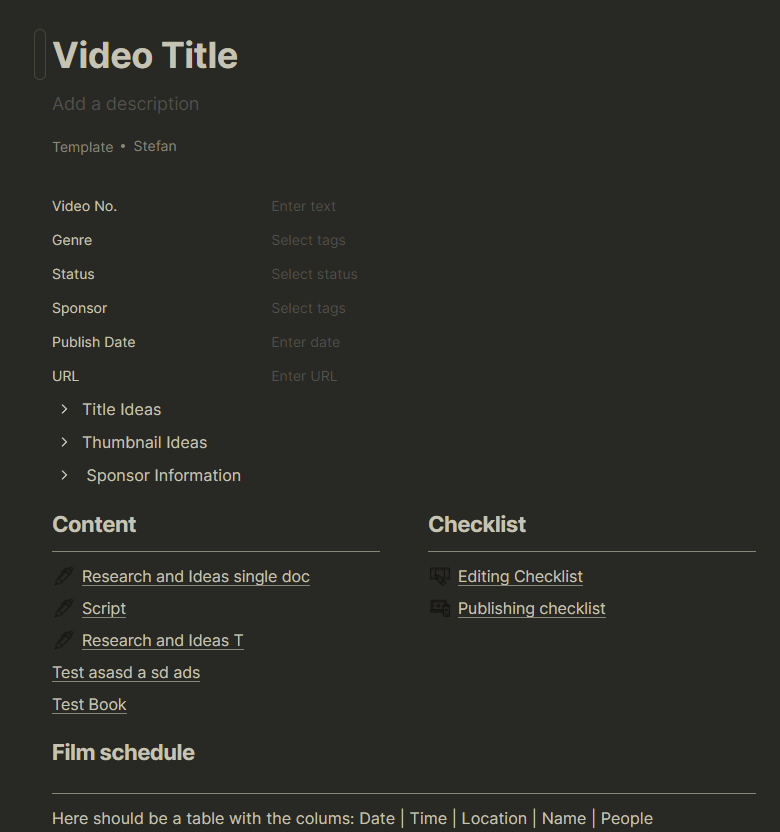
If i create a new template an link to a “Template of a note” or “Template of a new object” i created and i create a new object in the Set, a new object should get created, not everything should link to the same object.
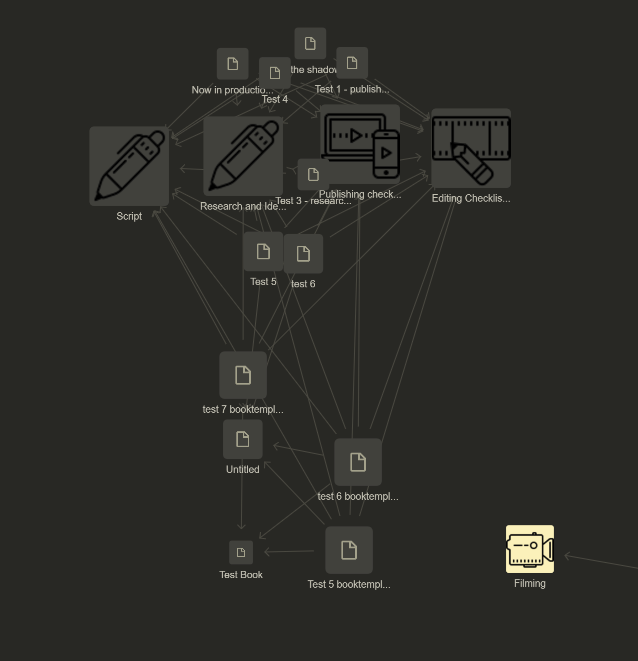
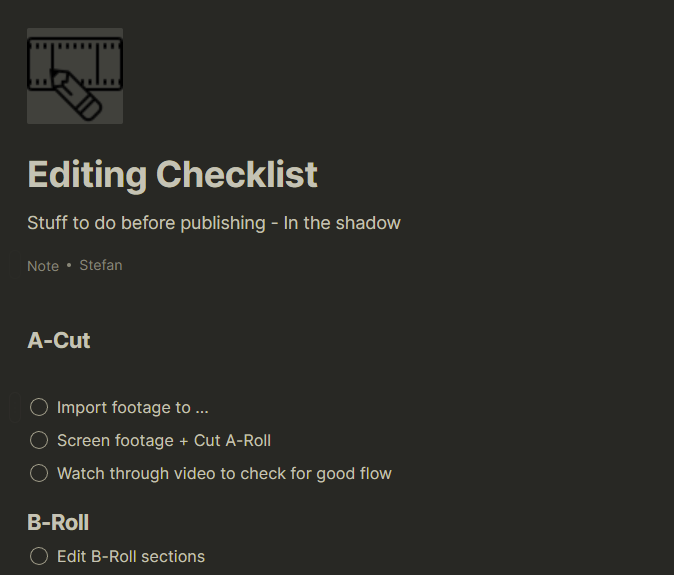
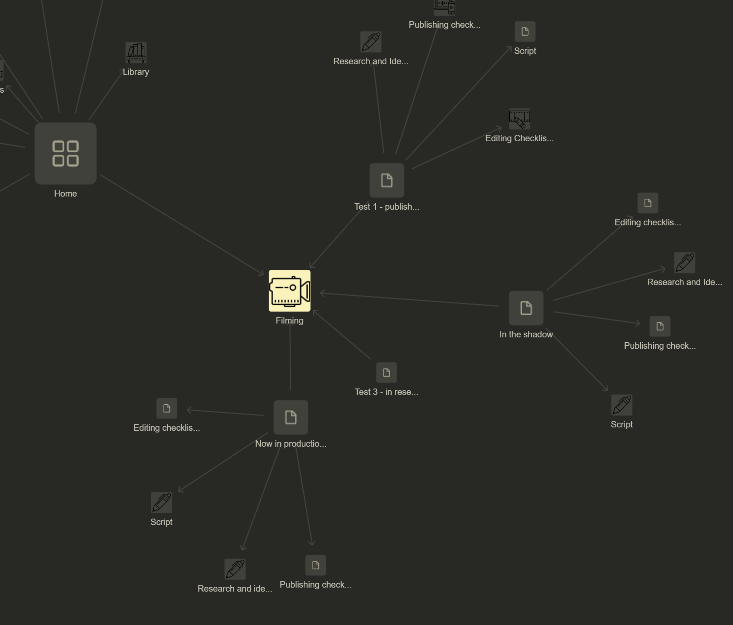
You see, every new movie i created links to the same “Script” and “Research” and “Publishing Checklist” and “Editing Checklist”. As i created the checklist already, it should be a new blank checklist for every movie, obviously, not the same checklist for every movie.
The issue How to create new note with every object created in a set - #4 by lynxlove talked about here: I don’t care, i can also create a new object-template “Publishing Checklist” (same level as Note-Object?) just for this purpose, i don’t care, but when i create a new movie-project i for sure don’t want to go to copy&paste the checklist everytime. Thats basically why there are templates, so i don’t have to do that.
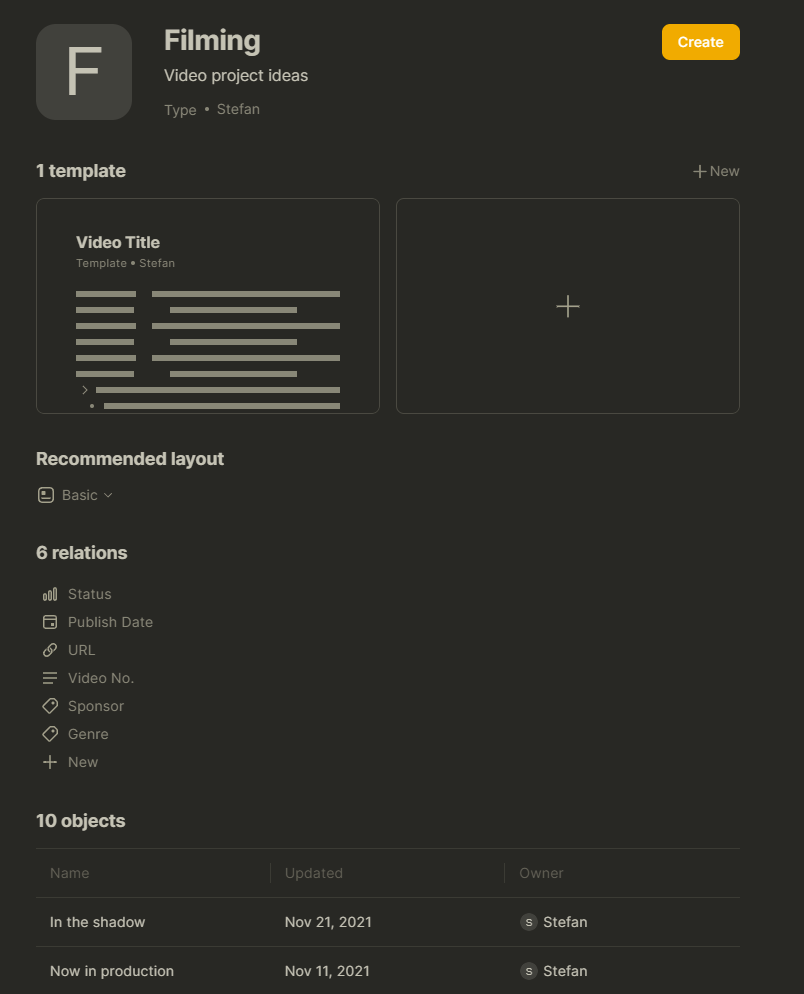
(i had to do the connection between “Filming” and the films itself manually, on a sidenote)
But the extra pages/objects should be created as well automatically, otherwise i’m just able to dump it all in one single file to create bigger templates. Thats suboptimal.
Funny, right now i thought about how i could rename this feature request better so it might get more attention. I thought about “Enable template within another template” for example. Another example would be “New blank/empty object when creating new object from template”. But i think the first one would be better - do you have a better suggestion @MrOrangutan ? Otherwise i might go with “Enable template within another template”.
This is actually a really good feature request as it raises some questions about the core vision for templates, relations and task objects. I’d like to see some discussion about this.
Oh my gosh, yes, this is a much needed feature. Faced exactly the same problem, only in the area of photo project planning. Have you come up with some convenient solution to this issue for yourself?
I’d LOVE this feature. Right now I’m really missing the Notion buttons. It’s so convenient to be able to add a template of sorts right in the middle of an object that is a blank slate and not just a link to another object.
I also concur this is a much needed feature.
As many, including myself have said before, templates are now a mishmash of things.
They are used as layout, and also to create an instance object out of a type.
Because t does both jobs, it fails at doing the job right. There needs to be a distinction between layout and defining a type.
I tried the other day to make a template for a project.
In the template, I wanted to create a set where I could input tasks.
Upon creating a new object out of project, I found out the embedded set (same for collection) is embedded from the point of view of UI, meaning I can interact with it in situ, but it was actually scope wise created on the space level. As all collections and sets are.
The only way to create tasks that belong to a project is with /task, outside of set or collection. Then, the backlink property gets populated with that specific object project.
You can then use a global set or collection to filter tasks by the backlinks property.
Unfortunately, this means that you can create tasks only using the /task method. This does not allow for a quick creation of tasks like you have with sets or collections. It also does not allow for great various visualisation of the tasks using views within the project object (as an example).
What is sorely needed is:
templates become true concept of ‘class definition’
layouts are used for just that - UI representation of a class (type)
embedded objects such as sets, collection, or any object in fact have the SCOPE of the object they are embedded in; they are not created globally
CRUCIAL DISTINCTION: sets should not be ‘owners’ of the objects they represent. Why? Because it breaks hierarchy. If I embed into a project object a set…and within that set I create tasks…the tasks through backlinks should be linked to the project, not the set. Presently I believe in such scenario, the backlinks is empty. This would allow the set within the project to create tasks fast, show only the tasks for that project (if you want, set automatically the filter: backlinks: object:the specific instance of project). It would then also allow to query still these tasks outside of the project in a dashboard using a set and property backlinks and even group in kanban by project
I’m a bit to tired to get my brain wrapped around all what you wrote here and in other threads about that problem, but did you know that there is a way that Objects have Links to the Sets they belong to?
– That was a real “hack” by another user 10 months or so ago. Very smart!
If you want, I can search for that.
Not the thread I was looking for and I’m not sure if it is the same way, but also this post describes a way to get Links from Objects to Sets automatically:
Thank you for this.
At first I did not understand there is a hack to link objects to its parents via a hack in sets.
Till in my other post somebody actually wrote up how it works.
I could not believe that works. In my mind it’s an anomaly, it should not be coded that way (and could make actually issues) but it does work!
I re-read it thank you. And in my other post I disagree I would go with that approach - although interesting.
I would never base a structure of my KPM on queries, but rather objects and their links. Sets are for viewing, finding things, etc, but not for holding the structure together. Doing that is not future proof in my opinion.
I just needed that info that setting a parent link as filter in the set would ‘wire up’ a child object to the parent (upon creation) and now I’m golden
Cheers
You wrote about it frequently. And every time I read this from you, I think you are somehow on the wrong ship. – This can’t be true.
But I admit that I never tried the approach myself, so maybe I’m here the person on the wrong ship.
I don’t get your comment.
There are many different workflows.
How am I on a “wrong ship” if I rather cautiously create structure in anyType based on interlinked objects and not queries? That puzzles me.
And yeah, if some things are not obvious, such as setting parent link relationship via queries (sets), one tends to post a lot to get help and figure things out.