I’m looking into Anytype and would like to understand if it is a good fit for me.
I’m not much into building a knowledge base but rather collect fun tidbits that happen and I might enjoy coming back to later. It is not a regular journal but more of a memory, I want to collect.
Currently, I’m using logseq and my current workflow is like this:
Open app with daily note present (date is captured)
Type memory like “#Kid1 did something funny”
Done
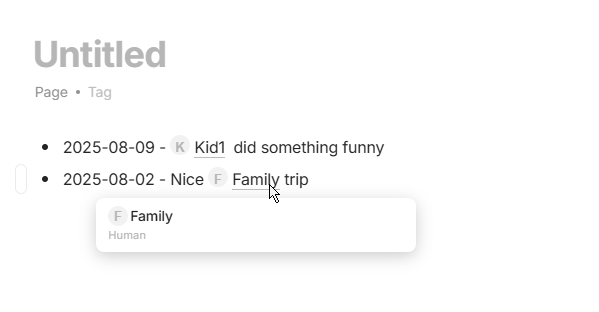
To review all these memories, there is a query for all blocks with a tag “#Kid1 OR #family” and they are shown nicely in chronological order next to the date the memory was captured, e.g.:
2025-08-09 - #Kid1 did something funny
2025-08-02 - Nice #family trip
I’m happy to change my workflow a bit to use Anytype better but so far, i have not succeeded. What is important to me:
Capturing should be fast and frictionless.
No Post-processing should be needed (for greater WAF)
Able to scroll through memories and “go back in time”
What i tried so far:
Create a “Person” type to link people
Create a “Memory” type (Note) which has a “Person” property
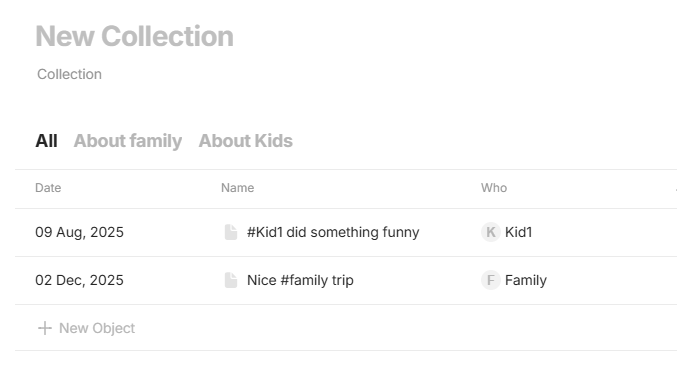
Create a view in the default “Memory” query for “ALL”, “family” and “Kid1”
Create a “date” attribute which is initialized to the current date with a template. I felt this was needed if i want to date back some memories that were not captured on that day.
To create a new memory in anytype:
Select correct view, e.g. “Kid1”
Create new memory, the “Person” relation is automatically filled properly (nice!)
Write some text (no title, it does not make sense here)
This is a nice workflow i could adapt to. Not too much complexity is added.
To view the memories - here is where I’m struggling. The query view does not allow to display the full text content and it also removes any formatting.
I tried creating a custom property for the text but this has lead nowhere
Custom CSS also does not seem to work (found some forum poster who tried it)
Any pointers would be appreciated.
Additional Context
I have looked into many other tools but my relatively simple usecase seems to be cursed. Only Logseq seems to be able to do it without too much effort.
I would like to move away from Logseq due to sync problems, overall sluggishness and, most importantly, not being able to onboard my partner to it.
Your usecase is not cursed It seems to be the use case of users that had their “click” with Logseq (or started with Logseq. In my case also with Interstitial plugin). So, your use case is exactly (or very similar) my use case!
You can have workarounds, which, depending on the workarounds, its possible on Anytype.
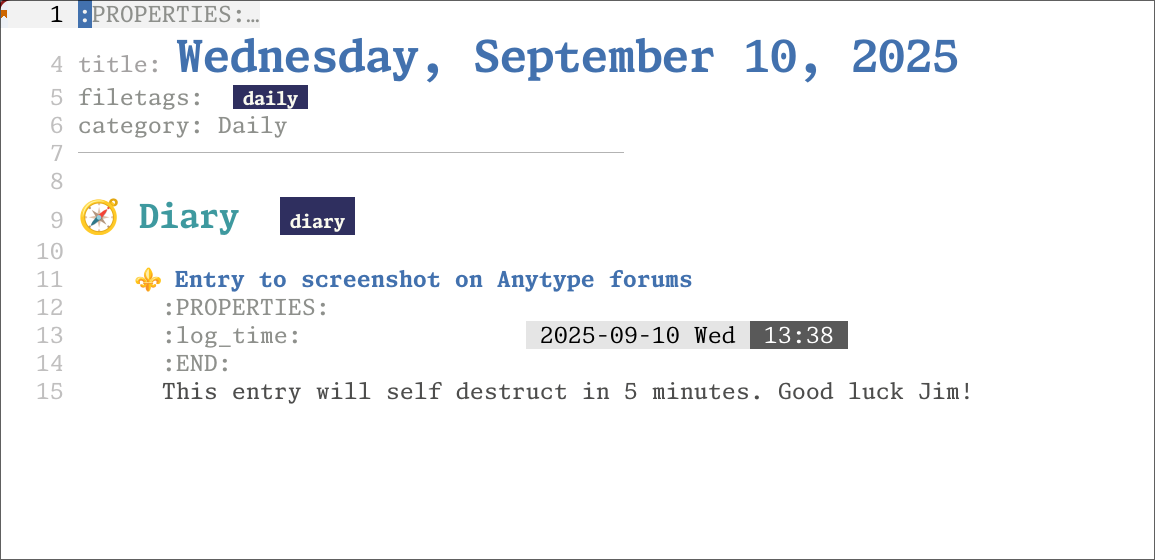
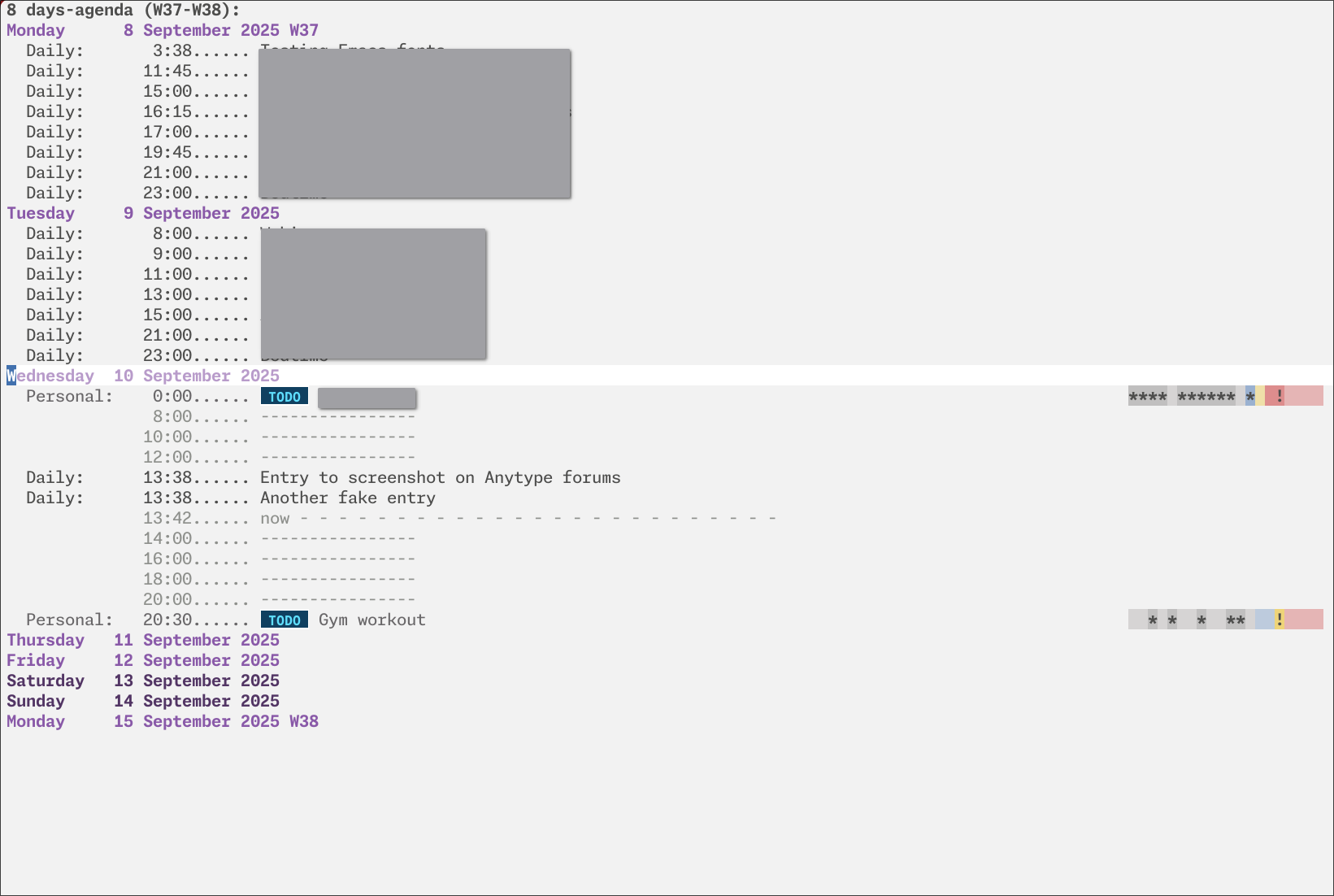
If you want pure Logseq behaviour, Emacs OrgMode is the only solution on the OpenSource world. (Emacs OrgMode is of course possible, since Logseq was inspired by Emacs OrgMode. Maybe also SiYuan, haven’t exactly tested).
But your use case is well timed! I commented on this use case (or very similar) on other topics recently.
In general, your process seems to fit perfectly with a product like Memos.
It’s also open source, self-hosted, and multiple users can share notes.
It’s mainly a format for posts and tags.
The process on Anytype, in my opinion, and the one that I think would work best, would be to create a “Daily Entry” object for each entry, with properties datetime (select time on date property) and allow multiple “adicional properties”, like ‘trip localtion’, ‘participants’…etc. (hence my excitement for the new tag system that may happen).
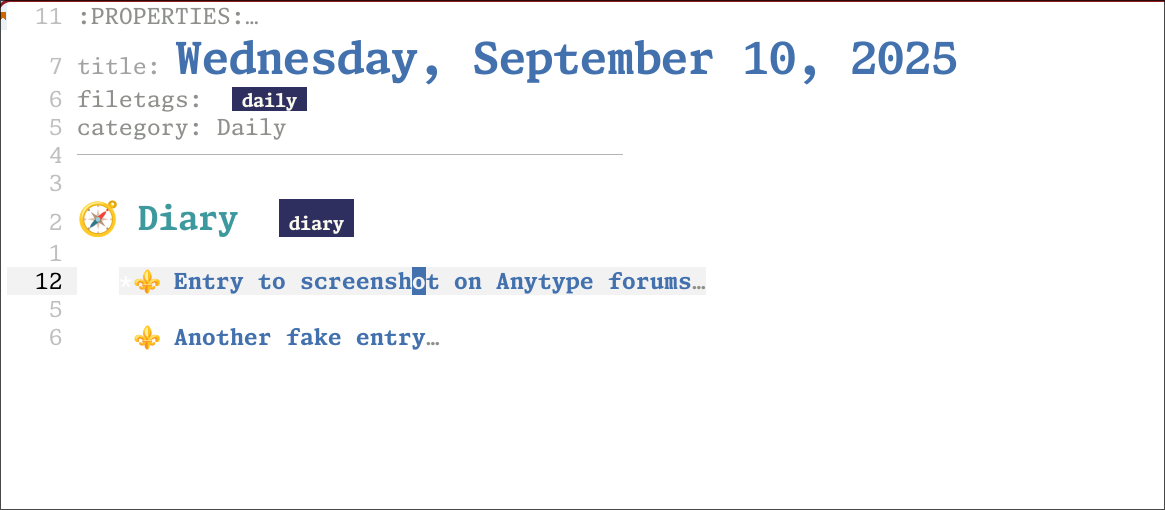
Note that on Logseq and Emacs, a Task is just a simple line/block, and on Anytype it is a full object. Makes sense that on Anytype, a diary entry would also be an object, just like the tasks.
In the case of then Anytype having “too many objects”, I tested having 100 000 (1GB of pure text) inserted on Anytype, and it works very very well (at least on my machine). Cool stuff that Space loading is async (how freaking cool is that! Anytype has so many nice tech details). (everything was fast and search was instance, but there was a place where it became slow, I will file the bug report later today).
No tag or linked block (I cannot find the related FR, I’ll edit it later)
Depending on the length of your memory, you can create a collection with the name, a date and a object relation to link to Human object. And create view to filter by what you want
The collection solution (adding to my sugestion to use single objects for each daily entry), would be that the collection, for example, “2025-09-10 Diary”, would have the date of “2025-09-10” and every entry created on that collection, or linked to that collection, would have the “diary date” of “2025-09-10”. This is kinda possible now, but not completely. Hoping that it may be in the future.
Also adding what @Shampra said, and my favorite usecase, I can do a calendar view with the days that I workout at the gym. (by showing in the calendar the date entries that have the property/link to gym workout)
But it could also lead to a very unpractical user experience.
Personally I also struggle to do a journal in Anytype. I had a calender and a list where each day was one entry.
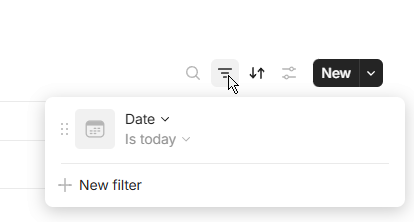
In my “Homapage” I had an inline query that only lists the journal entry for today, if there is none, I can easily create one.
But it is hard to have an overview, like having the context while being able to view the previous day next to the current one.
Everything is behind an object. I could query things with new queries that lists all appereances of a person for example, but I again get only a list and I need to click on each.
The nice thing about logseq and where the OP comes from is, that it’s easier to have an overview. you can just scroll through your journal / days and you can link to blocks directly to create better contexts instead of just linking to an object itself, that doesn’t give the current paragraph you are potentially in additional meaning or context.
(the bar with colors, “*” and “!” on the right are habit streaks, sucess and failures, according to that habit rules)
Pinging @anton , this is what I mean when I say that for now I have to use Emacs OrgMode for my “Second Brain” and Anytype for static notes/media management.
I understand Logseq has a different concept of, compared to other tools, what the smallest entity is. I’m not trying to force Logseq concepts onto AnyType. I just fell in love with it a bit and would like to make it work
What @Shamprasuggested is where I’m currently at. The memories I would like to capture are usually longer what can be displayed in the existing query views. Capturing memories as their own object is absolutely fine by me.
Side note: i quite like how silverbullet.md does the templating in that regard but it was ruled out due to the overall ease of use for my partner. Being able to provide your own handlebars style templates for query results would be lovely and also help with more complex scenarios.
How did you do that, that the date Property is initialized to the current date?
I also have a custom date Property that allows me to pick a date that’s in most cases identical with the Creation Date but can also differ from from it.
I thought it is impossible to initialize it automatically. Just looked again, but I still can’t see a way to do that.
Well, that’s embarrassing - i just thought i did. I created a default template which set my custom date proeprty to “today”, not realizing that this will not be evaluated when the template is used, but immediately.
What @Shampra mentions might serve well as a workaround.
@PaPaiya sorry, i missed your post about memos. Will have a look, thank you!
@sturdily Off topic: I love how Zeff is managing silverbullet. You can tell it is a passion project. I love how he journeyed through templating → space scripts → (trying to teach his son game programming) → implement a LUA engine in SB. I play with SB from time to time because i find the concepts, architecture and developer quite interesting but i haven not dared to commit to it.
A way to quickly capture new notes/memories with a custom date property set to the current day. Creation date will not suffice since some entries may be dated back when added to Anytype later.
On the bright side, you have a lovely community going Anytype has much going for itself and i really hope that one day it may also work for me.
This is not entirely true. The way we do it on Anytype currently, is through queries like @Shampra showed.
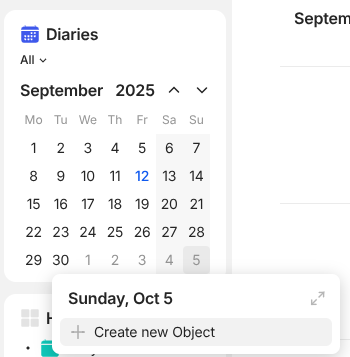
Also, you can do a Query with a view “Calendar”, and set the property to show of that calendar to the custom date property. That way, that custom date property will be set to the day you press the “+” on the calendar (allowing you do easily make an entry of any day). (tip: you can then put this query object as a sidebar widget, showing the calendar widget for easy entry)
Also, another workaround would be to have a “Daily” object, with all the entries, that would solve the view, but would break having the entries split by “blocks” like Logseq. (and work more or less like Obsidian).
Good catch! This even works with the property filter set to “Kid1” or “family”.
I was considering a single page for all the entries already. This is probably the “sane” thing to do
I like having distinct memories as their own entity. Mostly because it is easier / less error-prone to just add a new entity compared to editing an existing one when sharing the vault with family.
 It seems to be the use case of users that had their “click” with Logseq (or started with Logseq. In my case also with Interstitial plugin). So, your use case is exactly (or very similar) my use case!