I left Anytype a few days ago and my main problems were / are
I was locked in. It is completely intransparent how the data is stored and how one could do backups.
Math editing, especially on mobile was horrible
Scripting was not really possible / documented.
I gave it a try for about 2 years, but since around July I felt too discouraged from these points to even use Anytype.
Now my main problem is how to get the data out in a reasonable format, but I probably just restart anew to some extend.
I am now with Obsidian and the one thing that drew me to Anytype in the beginning – that one has objects and can distinguish e.g. movies, people, and scientific articles; but even after a few days I feel much more comfortable with directly having a backup via Git and such.
Ahem, yes, indeed, “difference becomes obvious immediately.” …
– Sorry to say that, but I’ve had an older Smartphone (Redme 9). And while Obsidian run on it flawless and surprisingly fast, did Anytype (after a while) not run at all. :-/
I vague remember that the hardware somehow not fulfilled some minimal specifications and Anytype did suddenly no longer support such “low-end” devices.
I can not remember to have ever experienced an app that refuses to work on that phone because of its specifications.
And as said: Obsidian run flawless, even with Graph and zoom and (if I remember correct) portrait mode.
Sorry to say that, but Anytype still lacks all that (and much more) features Obsidian has AND it does not even run on “low-end” smartphones.
My phone was cheap, yes. And it was some years old, yes. But I wouldn’t call it “low-end”. It wasn’t so bad.
Why is Obsidian able to run on it and Anytype isn’t, although Obsidian even has MUCH more features?
And I must say, that I was disappointed when Anytype suddenly did no longer run at all.
Because one of the reasons why I switched to Anytype was the fact that it also runs on Android.
And it it for a few months. Until that specific update came.
I love Anytype and I’m really sorry to say all this. As we all know, nothing is as hard as the truth.
Notion has feature parity bewteen mobile and desktop app, but the experience is so clunky (on both mobile and desktop actually), that it felt almost unusable.
Yes, I’d love to see kanban view on mobile (and more), but I much prefer the smooth and snappy app that we have now, rather than a feature-packed but clunky app.
I am sorry your experienced this. There should be a reason why it’s not supported - android devices very fragmented and some tech we use underneath for syncing can not work on all of them.
Great obsidian works well on your device with a lot of features. Obsidian is great if you need a single player mode and you enjoy it aesthetics.In our tests it’s different as soon as you have data there. It easily could take up to 20 seconds to launch and the app itself is sluggish.
Anyway my point was not about obsidian vs anytype. It was addressing concerte concerns about architecture. You easily can’t beat a native app with speed and responsivens if you use typescript. And it’s not about features.
Locked in which way? Could you explain what exactly feels non-transparent to you? Your data is stored in encrypted form on your device and you always have access to it. We provide a local API and you can export your data at any time. If you expect it to be stored in plain text then our app may not be the right fit for you.
Our mobile apps are not built for math editing and they will not support it in the near future.
Regarding scripting, we have a local API and people are already building automations and similar tools.
What exact problems with exporting are you experiencing?
Again I must say “sorry”, but I think the same as @kellertuer .
And again I must say: Obsidian wins in this discipline.
It’s a joy to look into the folder where Obsidian stores the information. The file names are perfect meaningfull, also is everything clear plain text.
Anytype on the other hand … it’s impossible to understand what’s going on in the folder where the data are stored.
Since then is it encrypted?
OK, it’s for a normal human being not possible to fully understand the data, but it was always explained that the lokal files are not encrypted.
I just looked into the mess - it’s in two ways as bad as possible:
The data are not encrypted. If a forensic gets the hard disc in his hand, he will be able to extract a lot (if not all) information from it.
BUT a normal human being that’s simply interested in normal tasks like backing up and restoring data, will not be able to do that.
Show the data folder to 100 normal persons and only a few (maybe five of the 100) highly educated programmers will be able to understand what’s going on there.
Do the same thing with Obsidian and nearly all 100 persons will be able to find and extract their information from the files.
That’s why I call “as bad as possible in two ways”. It’s not secure against professionals, but it’s much too complicated to benefit the normal user.
Again sorry to say that, but this is theoretical.
Let’s take me for example: I’m a self educated programmer. That means, I can write software (even software for selling), and I’m more competent then most normal users, but I’m not a highly educated pro. And at least for me, it’s one stair too high what the API offers.
What I miss btw. is a way to enrich Anytype with Addons.
I would like to write some addons if I could integrate them direct into Anytype.
But I’m not interested in writing a bunch of external mini-apps that do something with Anytypes’ data.
So for me, the API is in principle not existing.
And I suppose that I’m not alone with this mindset.
Again just theory.
I admit: exporting data into a useful format is complicated for a software like this, no question.
But the existing formats are known for the limitations, even importing them back into Anytype was often reported as faulty.
It would give a better feeling (against the “locked in” feeling) if there where a dozen different export formats and if some of them are well known.
I mean, what would you say is to do if a user comes up with the idea to migrate his data to:
Obsidian
OneNote
Notion
Etc. etc. etc.
I can tell you what my ideal would be:
A clear format like Obsidian. Filenames meaningful, the content readable in a simple text editor.
BUT everything is stored in a fully encrypted container, bullet proof even against NSA and CIA!
For backing up everything 1 to 1, there is no more to do then making a copy of this container.
And to decrypt the container, the user isn’t forced to use Anytype, her could also use TrueCrypt etc.
Anton, please see it as a constructive critic!
I love Anytype, I wish the project every possible success and I would wish it becomes even a standard that nearly everyone uses, so that I could chat with anyone simply using Anytype!
BUT we must stick to the truth!
There is still a lot to do, even after 6 or 7 years.
– Users feel like they’re being fooled when you keep sugarcoating things that aren’t actually good!
If @kellertuer complains about the feeling to be “locked in” and about the lack of transparency about the data and how they are stored, then he is right!
I think the same!
I live with that feeling, because I want to stay with Anytype forever. But it is risky and I know it and it gives a feeling of jeopardy.
Please do not coat that in sugar, better let someone write some more export formats. (But not Razor, he has enough to do!).
Fair comment. But has it occurred to your team that it might be best to lead with new features on iOS and Android first, at least for capture and presentation?
It’s true that “serious” work is still the domain of PCs and Macs. But mobiles are used 100 times more often. That’s fortunately not a problem for a note taking app, because the truly creative “serious” work, i.e. time spent sifting through the volume of notes and making sense of it all, is typically quite low.
There are numerous use cases for people sitting on a bus or hanging out in a cafe which would benefit from the richest and most varied set of capture and presentation tools possible.
But isn’t this already the case? For export, at least, Markdown is supported. That is the format used by Obsidian. It natively reads/writes Markdown notes. Anytype can export in this format. Albeit, it does not have the folder structure.
So, technically, as long as your (desktop) application works, you should be able to export your files into a “standard” format that other apps can use. Automatic file download is coming soon, perhaps in the next version, from what I see in the repos, meaning that export should now always have all the binary files available, as well (whereas now they are only copied to the viewing device on demand).
Perhaps you switched context at the quoted point and refer to a clean native format. They have explained elsewhere that they chose Protobuf as the native format for various reasons, mainly network performance, multi-platform serialization/deserialization, etc. But export to Markdown is there.
Each software is best at something. Obsidian is a folder-based markdown editor and it is great for people who like its aesthetics and usability. If you need a single-player setup and you enjoy how it looks and works, it is for you. But it is not for me and not for many other people.
Since day 1. So this assumption is wrong:
This you already can do in two ways:
Export in any protobuff format
Just by copying your app folder
They will come at some point. Anytype does not use a hierarchical system and you can export your data in markdown and use it in other software. Yes, it is not fully compatible if the app you are migrating to works differently. The same happens when you migrate from Notion; we cannot support all features of Notion. I do not fully understand this point because it is simply the nature of any software.
This will never be the case because it is incompatible with how our system works. If you want hierarchy, unencrypted data on disk with human-readable file names, and no real-time collaboration, then Obsidian is the right choice.
If you want encrypted data, object-based note-taking, and real-time collaboration, then it is Anytype. Regarding backups, we will soon release an easy backup method by simply saving the SQL file, which represents one space. It will be even more convenient.
it’s not even a critic. it’s just a wishlist based on wrong assumptions.
I do not know what you are talking about. The current version of Anytype, based on Any-Sync, is 18 months old. It took more time than we expected and it will probably take up to two years for the product to fully mature. This is our pace and it is fine. If it is not fine for someone, that is also fine.
To be fair, every software developer makes their own set of trade-offs. Anytype has been built from day one as an alternative to collaborative cloud software not to local text editors. That is what you should compare it with. Can you read your files from Notion or Slack on disk? Are they encrypted? Do they provide easy export? Do they avoid locking you in? Do they give you the degree of freedom we give our users?
We never tried to build an alternative to Obsidian and never intended to compete with it. It is a local-only markdown editor that is great in many ways. But it is not built for real-time collaboration. It is not object-based and it is not aesthetically pleasing. Please keep files and apples separate.
Fair point. We wanted to deliver the infrastructure and the three main formats we believe are essential: chat, editor, and bases. They are quite raw at the moment. The good thing is that they are here, and we can now focus on improving their quality. So the first step is better capture, and the second is better representation.
I wrote a longer text, but that is under moderation, so maybe my oppionion is worthless. A short comment on “Obsidian is a local text editor” – by far not!
There is two things Anytype can to, that Obsidian can’t: Items are types, and Anytype has a chat. And in the last post you even write to be an editor as well. If so, that is a very poor editor, at least from a stem scientist point of view.
Thanks @Code-Jack, you. detailed most of my arguments already.
I do not see the files in like at all. I now exported to Markdown – and will slowly go through the 1k+ files in one folder to sort and bring parts to Obsidian.
Yes it is right to call that “you can export your data” – but then it is just a pile of unsorted unusable files. Just imagine if VS Code or MS Word would let you work only like that.
But while using Anytype – the app broke 3 times for me. Some times I posted that here, like Personal space name broken? – where starting the App I was not yet “greeted” with an update dialog but you broke the data somewhere so before an Update, everything was broken. Had that a few times. No backups possible, just the hope you would fix it somewhen, App unusable for a few days. That is what I call locked in. I am 100% dependent on someone here fixing bugs or restoring my data.
Concerning the API an addition. In Inline LaTeX Addition a lot of people asked for inline LaTeX / Math. The answer was for a long time “nah, no one needs that!” from your side. I do math. As my day job.
When it came, it was still fully unusable for me, since in a paragraph I write, I might have 5-6 formulae per sentence. Did you ever check how far all that jumps when I leave a paragraph? Not fun in like at all. And there is no API that anyone else could step in and try it.
Comparison: In Obsidian I wanted to have a filename (not necessary to think about that on your side for sure) That reflected today’s date. Took me 30 minutes with a plugin to code that myself. But you do not have an API.
I am again locked in and have to tolerate being called “no one needs that” when I need math. And editing on mobile works like a charm in Obsidian as well.
The only thing that I miss a bit is, that items/objects have a type in Anytype (like People, notes,…) – but I am sure there is a Plugin for the in Obsidian as well.
So your conclusion is right, your App is not the right fit for me. What brought me here was the claim you are open source and the objects. You are not open source – and very limited in features (see this post and my last).
I gave this a fair chance and tried a bit of being active here as well, but I never felt welcome and more like the unwanted customer (who uses math anyways?!). Even your answer sounds passive aggressive as if I was wrong. That was my usual feeling here.
I have not yet interacted with the Obsidian community, but here I usually felt not welcome.
It is a feature, not a bug. Anytype is simply different, and it is not for you if what you want is a hierarchical markdown editor.
How can you compare Anytype with VS Code and Word? It is a completely different class of software.
The main feature of Anytype is that your data is always immutable, so you can always download an older version and use it with an older app. We are still in Beta, and the problem you are referring to is from 2023, when we made a major migration. Sorry for that. But it was not about lock-in. You can always revert to an older version, and there is no risk of losing your data.
When and where did I say that? As far as I remember, our position was that it is hard to implement on mobile. So we decided to deliver it on desktop without supporting it on mobile.
Is it still like that, or are you referring to bugs that appeared in the Beta after the release?
Cool that they have that. Just as a note, object-based note-taking is not fully compatible with a hierarchical structure, although you can try to emulate both approaches. We are focused on the object-based model.
Again, our most essential work is open sourced. The clients are under a source-available license, which only limits the ability to sell Anytype or make money from it. We are fully committed to open-sourcing everything once it is ready. How is this related to the topic?
I am sorry you are leaving and I am grateful you gave it a try. But based on what you are saying, it was simply the wrong choice. If you need a plain markdown editor, do not need collaboration, and are happy with Obsidian’s aesthetics, I am honestly surprised you chose Anytype.
I do not see how you can read my direct questions as passive aggressive. It is definitely not about us.
The comparison is not about features they have in general but the lock-in. Just imagine VS Code would say: Sure you can edit files in VS code, but what if you can access its content only indirectly?
In having an option to see the plain data, I could backup that manually, version control it myself, these things. Sure, you can then encrypt that optionally. But the current way, the data is hidden (far) away from the user beyond their control.
Oh sorry, I was imprecise here, the you reefers to “you the team of developers” – I did not mean you personally
I did not try since August, but per paragraph you show all math code as $...$ and only render once I leave that. So since math is a lot shorter that its formula, that did hop by several lines back in August still.
That was what brought me here originally, since it fits my trail of thought usually a bit better. But if everything I want to do is either not possible or takes twice the time – the change of thought model or looking for alternatives is the way to go.
Which is still closed source? This point was something that seemed very appealing to me at first but I am also very very disappointed about.
Sorry, I did use Anytype less and less this year and from May/June nearly not at all. That I then do not see every small update, sorry for that. The main things I did notice is feature that would help me, would be long postponed or discussed as not needed.
I spent more time trying to setup Anytype to make it usable and reliable than actually using it. One reason I stopped using it in May was that the App regularly froze (did not check recently though)
In comparing them when I choose first between Anytype and others, the Object-based approach sounded very appealing – and as mentioned the claim it was open source, which it isn’t.
Sadly I had to notice nearly nothing else is for me.
So thanks for the feedback, but I think for STEM people or anyone interested in their data, I will further propose other solutions than Anytype.
But I see the OP is also not so happy about me posting here. So it is time, to leave it be.
So, my assumtion is wrong?
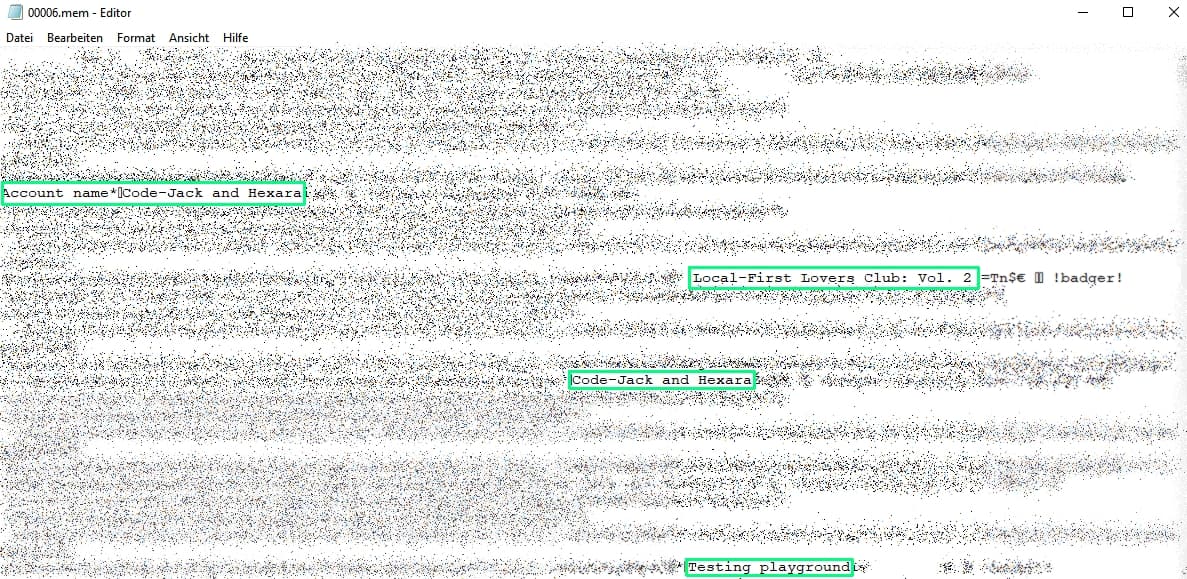
– Only one example:
In the folder localstore, in the work directory, there is a file “00006.mem”.
If I open it in a text editor, I see (among a lot data gibberish) in plain text:
At least the filenames of images can potentially bring a user into jail!
Or it can ruin his marriage.
Same for usernames.
And I can think about a lot more.
There’s not even NSA or CIA forensic software needed to ruin someones marriage or to bring him into jail; a plain text editor is already enough!
Such fragments of PLAIN TEXT(!) is not what I understand if we talk about “encryption”.
And I can only HOPE that Anytype’s super-duper encrypted sync protocol doesn’t work the same: that it blasts my secret filenames and fragments of my other secret data as plain text into the internet! :-/
I can tell you what I expect if we speak about encryption:
White noise.
No structures at all, nothing else then pure white noise.
And now to the other aspect:
“You can export your data …”
– Maybe I wasn’t clear enough: I have experienced more then once, that Anytype suddenly didn’t work anymore at all!
It doesn’t run on my phone anymore, as already said. But also on my Windows PC was startup or login problems. It wasn’t possible to enter my Vault, therefore it wasn’t possible to export my data.
Once it has happen when I was in the urgent need to access my data, but it wasn’t possible.
This is such a situation where I normally take a plain text editor and try to find with its help some needed data.
In Obsidian: no problem at all!
Once I’ve used an alternative for OneNote. It has stored its “Objects” as RTF files. – Well done, I can work with that!
But Anytype …
– That’s what we mean with “locked in”.
Yeah yeah, in theory there is an API and so on. But in practice, we are locked in.
If an export isn’t possible for some reason, or if exporting/importing into another App fails, then it is as if our data are in jail. Locked in.
If we are lucky, we have an older markdown export. Hopefully it will help in such an emergency situation.
As for the rest of your discussion, I’ll let you continue (my opinion differs, but that doesn’t matter). However, on this specific point, I disagree,I also don’t understand the comparison.
Anytype is not a text editor; I wouldn’t be here otherwise! A text editor must be able to read a human-readable file, yes — that’s literally its purpose, isn’t it?
If we’re making comparisons, then let’s compare it to MySQL (or any tool that uses this kind of database — good luck trying to read those files directly as plain text…).
It’s also worth noting that VS Code itself stores data in non-readable files, so if you insist on that comparison, go ahead and try reading its internal files (there’s at least some SQLite in there, as far as I know).
And if KeePass suddenly allowed me to read its database file as a flat text file, I’d drop it immediately .
Probably the same for Anytype, actually. I’m not looking for a file editor.


 .
.