If I could, I’d definitely fork it, fix a bug or add a new feature, and then submit a pull request. That would honestly benefit Anytype even more than simply reporting a bug or making a feature request.
If i knew how to code. I’d do it myself
Actually, I did it with a few features that were important to me.
But Anytype is constantly changing, making it difficult to keep up to date, so it’s not viable for sharing and use by third parties. Sorry.

And import and export should be completely complementary - whatever I export should be importable with 0% distortion, and whatever I import should be exportable with 0% distortion. This, at least, should be the goal.
Yes, but here you already run into ambiguity or a wall, depending on how you look at it.
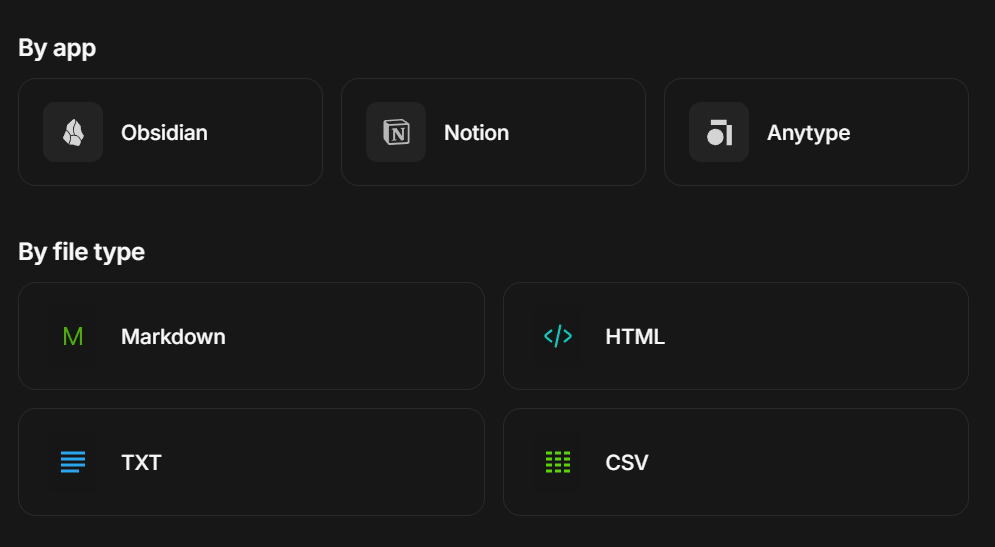
These are the supported sources for import:
and these for export:
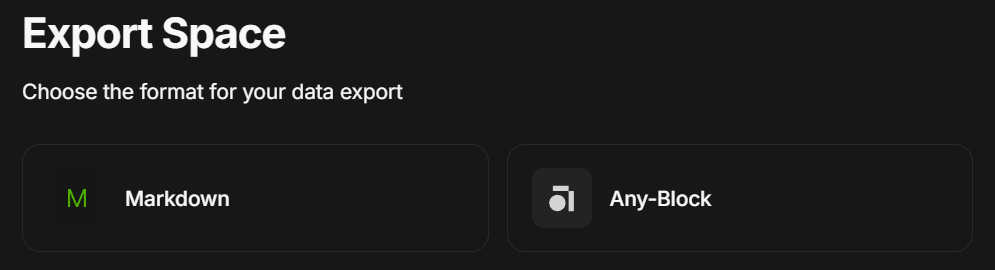
The formats in these two groups are not really compatible so it will be technically impossible to guarantee 100% equality between the imported and exported data.
From what I understand, the devs have stated that import/export through the AnyType format and Protobuf is guaranteed to be the same because that’s what is used underneath. That is the native data format. Everything else will have discrepancies.
I mean, I fully agree with you, though. I would LOVE to be able to have a Markdown vault as a reference, where I can dump the backup every now and then. That is how I’m trying to move the notes from one system to another. And, I can tell you, it’s a major pain in a bad place!
For example, AnyType has a linear structure, no hierarchy. There is a request for some sort of support for hierarchies and that could be used to create subfolders. SiYuan is doing something similar and supports export to subfolders. But, so far, I’m finding it really difficult to import and export Markdown notes from one system to another. They all have their quirks and some unique features are done in their, well, “unique” ways…
I’m not sure I expressed clearly what I meant. I just have a very basic, reasonable need: if I export a set (query?) to .csv or .xls*, then when I import that same file back to an empty set, I should be able to get the exact same set I started with. I wasn’t thinking of mixing up import and export formats.
IMO, there’s a lack of good open-source alternatives. Recently, however, I rediscovered Obsidian. I use it in combination with their Web Clipper and a few community-made JSON configurations for IMDB, YouTube, and Goodreads.
Thanks to this, I no longer need separate plugins for my databases of movies, books, TV series, and music. I manage to collect this information literally with one click and completely hassle-free. On top of that, they recently released an API for their database.
Obsidian used to seem too complicated to me, but now I believe it’s heading in the right direction. I’m just sharing this as a personal experience, not to advocate for the application.
I will definitely take a look at Obsidian.
If Anytype doesn’t get their shit together.
Are their updates consistent across platforms? ( Android, IOS, Desktops)
Well, I have left Anytype. Its promise (the object paradigm being number 1) kept me using it way past when I should have gone.
Two showstoppers
- Like many others, I can’t handle the major lack of parity between the mobile experience and desktop. I’m mobile first.
- Lack of a url scheme, which can then be used for integration. No app is an island: I run just a few iOS shortcuts which stitch together apps such as Things 3 and Calendar. Yes, I can get some weird link out of Anytype to point to a page. But I want to be able to do much more than that.
I’m now using Obsidian. I have no idea how they do it, but their mobile apps have almost exactly the same functionality as desktop. Even to the extent of the insane number of available plugins. They also have two stunning features: Bases, which is a high performance way of presenting filtered data, and Canvas, which is a whiteboard paradigm.
The problems with Anytype mobile make me suspect that the underlying architecture hasn’t been thought through properly?
Nonetheless, here I am in an Anytype forum. I still live in hope that it will get to where it should be.
Also “publish to web”, and others:
- Editor experience - HTML escape is so terrible. It feels more like some half-baked HTML/Markdown hybrid. Although you can’t use HTML tags directly, and still everything just behaves… weird. And code block(not code snippet) is terrible too when I editing it
- SVG icon - You can’t use them in everywhere and customizing them is a mess. There really should be a proper “icon library” built in
- Toggle/Collapsable headings (!!!)
- Canvas/Whiteboard workspaces
In that order.
It’s still feasible to use another app for whiteboarding needs, but the toggling headings are huge. I committed to paying for anytype for a few months, I like it a lot, but its aggravating to basically only use it as a really cool folder system (and for quick-capture)
With Notesnook just releasing the collapsing headings, its temping to leave. Anytype’s linking/connections are still heads and shoulders above Notesnook (NN), but NN’s tagging/linking is good enough if they get a whiteboard/canvas, then it will be enough to jump.
Still, thank you all for what you do! This app is a great idea, it might be the future of note-taking/PKM apps.
Well abt whiteboard/canvas. It’s a complicated task to even find the correct one to use. Unless they code it themself.
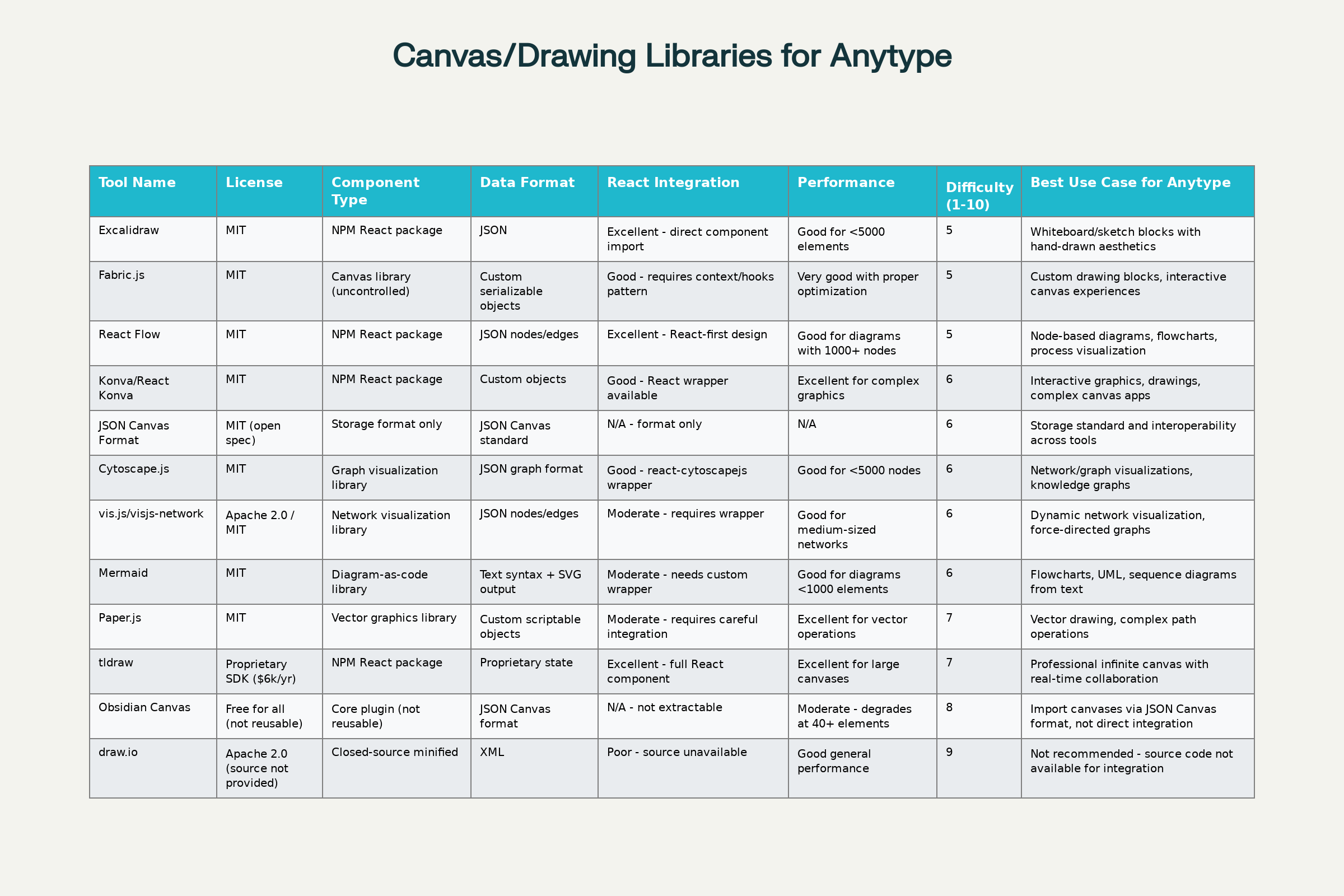
they are already experimenting with Excalidraw
Yeah, looking at this list, I think Excalidraw is the best option, honestly. By the way, is there a way to follow the progress on the GitHub repo for anytype-ts?
I’ve found this: Feature/JS-3685: Excalidraw by ra3orblade · Pull Request #468 · anyproto/anytype-ts · GitHub
Oh no! =:-(
Again one of these giant new construction sites, instead of investing five minutes work to finally give us backlinks for images!
Man, relax. It’s just en embed. And backlinks for images are coming.
1.) Multi-Tab Support
For me, multi-tab support is a critical missing feature that currently prevents me from fully committing to AnyType.
Most alternative note-taking apps (Notion, Obsidian, Joplin. Logseq, Craft, etc.) offer tabs as a standard feature. Working on multiple projects simultaneously requires quickly switching between different pages without losing context. Tabs make this seamless and efficient.
Currently, the only workaround in AnyType is opening multiple windows. However, this does not work reliably – especially on macOS, windows become empty or unresponsive after the system sleeps or the app runs in the background for a while (I’ve filed a bug report for this: Issue #[deine Issue-Nummer]).
What concerns me further is that tabs are not even mentioned on the official roadmap yet, despite being a standard feature in competing apps.
2.) Block-Level Linking & Transclusion
As a second feature, I would also very much welcome block-level linking and transclusion. Being able to link to specific blocks within pages and embed them dynamically across different objects would greatly enhance my workflow for knowledge management and modular documentation.
These two features are among the few things holding me back from making AnyType my primary tool, despite loving its privacy-first approach and overall design.
Seems to me they still don’t have a clear roadmap. They also don’t seem to value user requests — some of the most requested features in this forum have been sitting untouched for ages. I’ve also seen them promise certain features and then walk those promises back a month later.
Personally, I don’t see a strong future for the app in its current state, but I honestly hope they can turn things around and deliver on what they’ve set out to build.
Multi-tabs are comming soon.
I’d actually say the opposite is true. We build fully native mobile apps — which gives us far better performance and responsiveness than any React-based app can deliver. Obsidian reuses the same codebase for desktop and mobile, which is why they have feature parity. But that approach also limits what you can do in terms of speed and smoothness.
You can always add missing features over time. What you can’t fix is the inherent clunkiness and latency of a React app without rewriting it natively.
If you try Anytype on a low-end Android device and then try Obsidian, the architectural difference becomes obvious immediately.
We’re still early, and closing the feature gap is part of the plan. Right now we have one full-time iOS engineer and one full-time Android engineer, so bringing full parity naturally takes time.
For some people, feature parity matters more than responsiveness — that’s fair. But we’ve intentionally chosen a different set of tradeoffs to deliver a smoother, faster, truly native experience.