WHAT DO YOU RECOMMEND
‘filter’, ‘view’, and ‘relations’ recipe-like templates for sets/collections. for an automated reproduction of previously configured structures.
HOW COULD IT BE DONE
by introducing templates to sets/collections that capture the queries and predefined ‘views’ and the filters assigned to them.
REAL WORLD USE CASES
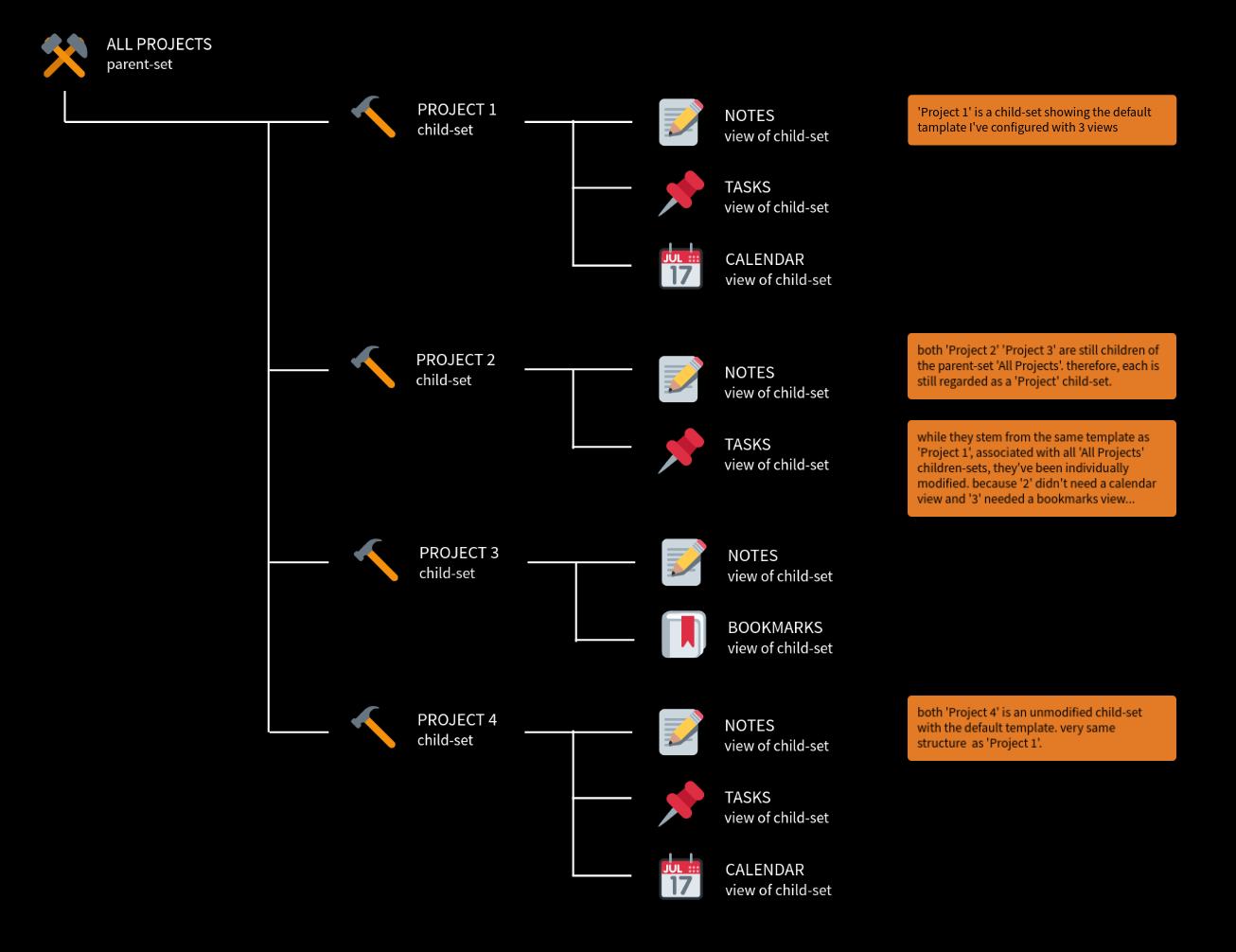
currently I find that my best way to manage my projects on Anytype is via collections (sets would be ideal but currently seem impossible more on that later). 1 project = 1 collection—the reason is that each project of mine is like a space in itself, having its own notes which house my thoughts, own to-dos and events, own resources and bookmarks.
one project’s objects are disconnected from the objects of another. I suppose most people would create a page for that but I prefer collections due to the ability to display the project’s ‘notes’, ‘tasks’, ‘calendar’ and so on, in separate views (tabs). it’s far cleaner than having it all laid out on one very long page.
KEY PROBLEMS
-
the biggest issue I have is that I cannot preconfigure collection objects the same way I can preconfigure note objects using templates. currently, my way of creating a new project is inefficient. since a new collection cannot inherit the ‘views’, ‘filters’, and ‘relations’ configuration that I’ve already developed previously and I have to do it all over again every time. (it’s possibel to make one instance and keep duplicating it. this is still inefficient. I’d like to simply press the add new button in my ‘projects’ parent-collection, which would automatically create a preconfigured subcollection for my new project.
-
I’d like to use sets instead of collections. the essential point of this thread is an automation of this process as much as possible. collections are all manual. sets have the ability to display objects automatically based on queries, which in theory makes things easier but as they cannot inherit relations at the moment, it’s impossible to use them for this purpose.
-
the whole concept of sub-sets is necessary for such automation. not only a subset/subcollection must be able to inherit preconfigurations but also, a parent-set/parent-collection must be able to produce child-objects that already have a preconfigured template by default. (that’s currently only possible using objects such as 'note, task, and more, that can inherit a template).
I’ve already asked around for advice and got the following reply:
this is @Axis’ answer to the same ‘missing feature’. they also summed up their comment saying:
their solution is a creative work-around indeed. but take a quick look at their configuration—it’s all very manual. they’ve built upon Anytype’s existing logic an ‘Index’ relation system.
an index = a project. and now, whenever they want to simply add a note into a project their project, they’ve got to take the long way of creating an object, sticking an index to it MANUALLY, then they have a ‘secondary index’ relation, which defines this object as a ‘note’ or a ‘task’. ONLY THEN they’re free to fill in the content into the note/task and off load it of their mind…
ideally, when @Axis wants to log a new project into their Anytime database, they’ll enter their ‘projects’ parent-set, which only displays ITS children-set objects (each child-set is an individual projects that already has the predetermined template of views and filter, housing only objects related to it, aka project ‘notes’, project ‘tasks’ or what not).
then, if @Axis wants to add an object (note or task) into a project, they’d only have to enter the specific project’s set and press the ‘add new’ button which would automatically create a new object and place it inside the dedicated project set. this object would be automatically defined as a ‘note’ or a ‘task’, depending on the default object type set for the view tab @Axis is currently on. the default template associated with the default object type of this view would also be automatically applied. and they’d simply be able to immediately write down what’s on their mind without all the indexes faffing and reconfigurations.
related issues
-
something similar but less elaborate was suggested by @raph
-
@Shampra struggled employing sets and opted to manage their projects manually in the form of collections instead.
- my response to a suggestion to use a default collection with all the instances set within, that I’ll keep duplicating on end: