Do you mind just creating a FR for reducing the number of clicks needed when using menus? I’ll then share it with the design team.
You can add your other feedback to the topic later.
I was intended it to make a post in Any talk Today or tomorrow Writing my thoughts about this specific issue. and my suggestions to better solutions using Visual concepts. I will write only in better solutions for Creating relation and better Filters Layout. for now.
Hi @Code-Jack!
First of all, thanks for the feedback, it is very important for us that you continue to use Anytype and support the product! Just wanted to address some of your points, speaking as Anytype sync protocol and middleware dev.
When you are designing a local first system built on CRDTs (in layman’s terms - data structure that allows multiple computers to update shared data independently without a central server and still keep everything in sync without conflicts) and encryption schemes, you face a lot more obstacles. Also you don’t have a single point of synchronization and control (like in traditional web2 world with central database).
So with a lot more added variables we have to design many things from scratch (e.g. sync protocol, CRDTs, collaboration primitives - ACLs and their connection to CRDTs). But that is not all. After you design all of that, you have to build new features on top and upgrade the old ones. So that means you need to write migrations etc. But in case of different devices with different versions of Anytype with different OSs etc the things which can go wrong are endless and we have to take all of them into account.
Most of the other apps have just web version which works with data on the server, which is easily migrated and changed etc. We don’t have that luxury, that is essentially a price for robust and complex end-to-end encryption, peer-to-peer collaboration, usage of files etc.
But for us privacy, offline usage, encryption and peer-to-peer work represent core values, which are very important for all the things we do. So we have to design and develop every feature with these things in mind. So that’s why it takes a lot more time to develop new features which would be a lot easier to develop in case some of these core values were not complied with (like in web 2).
Perfect example 
This is indeed possible, but no less difficult than finding one’s way through a maze without ever looking back. In fact, I have been using similar software lately, which is a note-taking software developed by a college student with quite extensive functions. However, after some time editing, the software becomes laggy and many quirky little bugs start to appear, which makes me understand that there is no silver bullet in software development.
I can give you another example. Affine, a team comprised of renowned Chinese front-end programmers, still falls short of delivering a flawless user experience, despite the abundance of expert talent.
I can’t agree more! I silence and leaving Anytype just because of this. I would say, the developer team did many great things and big things in the past, but they seem didn’t realize there are so many tiny little things in the app which nobody cares about, and that’s the things which make users run away from Anytype.
I stop using Anytype almost a year, but I’m still watching every single Anytype’s update, and it disappoint me again and again. It just feels like they are making something with a Motocycle outfits but using a bicycle padel as engine.
Not disagree that there are a lot of “basic” things missing, but I feel its the opposite of that analogy: It has a Ferrari engine, but electric windows, no radio, no air conditioner… So much possibility, but its still rough on the edges.
A API/Plugin system would probably do wonders.
Plugins can do many things but not everything. For example if second side (right) panel is missing, third-party devs cannot put small calendar or content element on it.
As I’ve written elsewhere, I’m skeptical about the release of some features planned for the end of the year. In the best case scenario, we will see the first part of the API being developed in the next 2-3 years. It is clear that the choice of software architecture slows down and complicates the development of new functionalities. Maybe there are other factors that we don’t see.
I don’t know what to say. Logically, Anytype can handle everything but the problem is inefficient. It sometimes makes me feel like I can handle things more quickly on traditional papers.
Anytype is great because it’s secure, open source, and stable syncing between devices. I respect the vision and hard work of all contributors and developers. However,
- As a note-taking app, Obsidian and Logseq offer a better flexible experience.
- As a task management app, TickTick and Todoist offer a better task-tracking experience.
- As a project management app, Clickup, SmartSuite, and Monday offer a better complex project tracking experience.
- As an all-in-one app, I don’t see any perfect tools on the market but one worth mentioning is AffinePro.
To me, Notion is the most functional all-in-one app in the market but the workflow was not as productive as I thought. AffinePro just simplifies everything in a tricky way from Notion.
Furthermore, the keyword Visual Note-taking App is the most concerning keyword for me this year. It seems to have many surprising features for me, and I think that can solve the efficiency problems of most all-in-one tools that are currently on the market.
In conclusion, Anytype’s product positioning seems awkward between them. Should Anytype be considered to be one of the Visual Notes-taking based apps in the future?
Edit:
There should be one more potential app that worth mentioning - Superlist. It’s currently at the very beginning stage. I think the development situation of Superlist is similar to Anytype, they are both waiting for a decision driving them to their unique kingdom.
Superlist seems to have a clearer mindset at the base architecture when compared to Anytype, but right now it getting stuck on overly relying on the power of AI features, they seem not very interested in implementing some hot features that we can see on the market. However, when excluding the privacy problems, I think even Superlist doesn’t offer many features at the moment, it’s still one step forward to Anytype.
Well… I want to be clear that I do understand what you say, and see the “inefficiencies” myself too. Mainly my point is that I understand why is so hard to make very fast developments. (although I have to say that multiplayer was done faster than I expected).
Why? I have tried it, kinda since when found out Anytype too, and I stopped testing newer versions. It just seems unusable to me to do anything I want.
I don’t want to disrespect Affine devs, some which I even recognize of great deeds elsewhere, and from what I got, I should only start testing it from version 0.17, which will start getting basic things for my needs (which Anytype already has/does).
But why is it so great “currently”? You can msg me directly if you want. (disclaimer: I don’t use canvas and don’t see any purpose of it. Maybe if I had a digital writting pad, I would have a different opinion).
As for Logseq, is in “maintenance mode” while db version is being developed. For at least a year now, possibly more. It does seem promising though, from what I tested. But its still so much broken.
At this stage, for me, there is only one “better app” than Anytype: → Obsidian. But Anytype has features which I value greatly and Obsidian does not. (“open source/available”, P2P sync, just to name two)
EDIT: ---------------------------------------------------------------------------------------
Well… but you can put it on the primary side (left) panel:
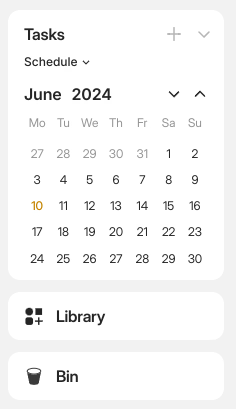
EDIT: Clarify that this is a separate branch, and not in 0.41.0 just released!
Right panel will be developed later, widgets branch has a lot of refactoring made to make this happen.
Actually, the AT team takes every part of development seriously, and there is no doubt about what they have already built. I just can’t wait to see it growth to be my primary tool.
When I said it is worth mentioning it doesn’t mean AffinePro is currently the best in the market, it’s still lacking some of the must-have features. Moreover, the best thing AffinePro did is the concept of combining the Document and Canva into one source, Canva can even edit additional information to the document but not impact its content. That makes the document’s feature not traditionally limited by tags, metadata, links, titles, descriptions, and content. It lets users flexibly edit and overview all related things and different types of information in one canvas, and that’s the point that most apps can’t do well.
- You might say graph view can do the same thing, but the fact is the graph view only shows you a few dots and a little bit of information before you click it.
- Or you might say mind maps can do the same thing, but the fact is mind maps are always limited by the way they work.
- Or Anytype relations can do the same thing, but the fact is, in most cases, it requires more steps to find and confirm that’s the things I need. Another method is, that some users might like to group things up into different sections within a page, but honestly, it keeps me switching between pages again and again, and it’s properly not a productive way.
Additionally, try to imagine the situation of using a note-taking app, when we click on a tag button, then the UI will send us to the tags page, or show us all docs with the same tags. At this point, when we talk about productivity, I would always expect how much key information can appear within a limited space at the same time, and what if I don’t want to only see the tags-related information after clicking the tags button? Once the UI is designed, everything is limited.
When most apps try to design the best UI/UX, most of them get stuck in their design logic, which means UX is limited by the logic of UI design.
In contrast, AffinePro offers a great Canva interface which is the freedom to work with the way you want, it doesn’t limit a cell size or a grid positioning, etc., it just gives you free space to put in whatever information you think is related to the doc. You can group everything in a small space and only use your eyes to search for the key information on a page without spending a second typing a single word for the query. The only situation that uses query search is to search for information that is not directly related to the current doc.
Right now, AffinePro is not my choice, but it shows me the possibilities of how the best all-in-one app might look like in the near future. And I was just here to sharing my points of view.
I have do admit, you did a very good sales pitch  I will look better at the canvas, I …quite discarded it, because its not my way of looking at info, but maybe its not what I thought.
 OMG, I’m not selling anything else, I just take seriously thinking about what an all-in-one app should look like. Since the keyword Visual Note-taking App comes to my mind, I can see the breakthrough in some limitations of most all-in-one apps’ competitors.
Visual Note-taking is not a fresh word, but it is possible to take the place within the ultimate all-in-one product based on the below benefits:
- Easy to memorize things that are related to a specific topic.
- Easy to stay focused on one whole structure of thing at a moment.
- Easy to track complex things in the headline-based style.
- Free and easy to manage a complex structure in a way with a full personality style.
- And more…
When you search the word Visual Note-taking App on Google, it’s easy to find out what people are trying to implement in the niche market. And here is an old and interesting one - TheBrain
While TheBrain doesn’t offer you a beautiful UI, and it’s not a new tech, but its concept is kind of a breakthrough for current market. A mind map-based note-taking system like this is getting very close to the headlines-based concept that I mentioned. And they are both great for handling an extremely complex structure in our brain.
By the way, it’s exciting to see what’s coming up in the future, it’s just awesome! And I hope AT can get some inspiration from the apps that I mentioned.
heh… it was just an expression
Hum… I think I heard about it once or twice, but never looked at it. Seems nice, expensive, old (like 27 years old), saw Jerry’s brain WOW!
In my personal opinion, its not for me. Very “mouse intensive”, very clunky and visual. I am more a keyboard guy (OrgMode, Neovim, Logseq/Obsidian). I like the graph, but only as a visual “map”, not as to be working on it.
But that is just me, and I know I am not the normal user case.
If there was a Linux version, I would test it, but there isn’t  But it seems like a great piece of software, just target to more “Visual brains” I guess.
Ha, it’s definitely an old software, I highly doubt it didn’t come to the top market just because of the high price and outdated UI, but the concept is still valuable for now.
OrgMode is great but a steep learning curve for me. Obsidian is probably the right choice as an OrgMode alternative for me if I have to choose between them.
Not at all. In my thoughts, it’s not only about visual brains or not, it’s about how much necessary, useful, and accurate information is shown in one space at the right time after each user’s click. What I’m thinking It’s all about productivity.
Everyone has a visual brain but triggers in different ways, there is no absolute answer says visual note-taking is not fit for a keyboard guy, it is just about what productive means to you.
- Productive of writing?
- Productive of controlling?
- Productive of thinking?
- Productive of learning?
- Productive of understanding?
- And more…
So, what if you care about all facets of productivity? And that drives me to think about How. To me, whether a visual guy or not, text is also a visual, when talking about implementing a productive tool on the screen, it’s all about how to show the information to the user’s eyes that can help them more quickly get all the work done. And that’s a concept of how an ultimate all-in-one productive tool works for everyone. Visual Note-taking is just the name of a method that is most concerned about how to position the information, but the concept itself also works for text-based systems like OrgMode.
So, whatever appearance of the app, if it’s productive, that’s would change everyone’s minds who cares about productivity.
I need to say that I totally share your experience regarding FRs about simple, basic functions that seem forgotten.
I am not talking about formulas… Geez! I want so many things fixed or improved before getting to that… Tables? unusable in the current state…
I must say that I have lost the GREATEST enthusiasm I have ever felt for a project… yet from time to time, some stuff still arrive… justified text ! Yeahhhh!
I have been on it for four major updates, I am patient… but I have no clue about what the team thinks v1 should look like and when they wish / expect / worse case scenario foresee to get there. Are we gonna see v0.78 before getting to v1?
I also understand the politics (regarding investors) that might drive feature prioritisation but I don’t understand the fuss about collaboration… If a person like me lost enthusiasm, there is no way that the random user would accept collaborating with me using the tool in the current state. I wouldn’t even propose it !
This being said, I did move everything from Evernote to Anytype and …
It does the job.
It could be better, I feel often limited.
It should be nicer, I feel many times annoyed (not being able to indent text after a heading…Duh !!!, Colours… man, when themes are coming!?, IOS version is so limited )
But it still does the job.
This feels on point to me. If the the single user use case is not satisfying, the product is not ready for collaboration features.
My plea to AnyType would be to focus on the frustrations of passionate users, not follow a roadmap to uncertain users.
On the other hand, perhaps it makes sense to prove that collaboration is possible - both to users and investors. Even tho the current implementation, lacking the ability to share a single page, feels lacking.
We started a new project dedicated to the UX, if you could share all main pain points it would be immensely helpful! The first pack of changes coming in the next release. Would be happy to go through your list and solve it.
It’s nice to read that!
I’ll update this list tomorrow.