Anytype emerges as a pioneering platform designed to transcend traditional knowledge management by offering a robust, decentralized, and object-based environment. It uniquely positions itself to empower both individual knowledge mastery, aligning with the “Second Brain” methodology, and the emergent capabilities of collective intelligence, forming a “Social Brain.” The pivotal element enabling this dual functionality is Anytype’s sophisticated “type” system. This system moves beyond mere categorization, providing a flexible yet structured framework for organizing, connecting, and collaborating on diverse information. By combining local-first privacy, peer-to-peer synchronization, and Conflict-Free Replicated Data Types (CRDTs) with its adaptable type model, Anytype offers a new paradigm for digital sovereignty and collaborative knowledge creation, addressing the limitations of centralized cloud-based solutions.
The Personal Frontier — Cultivating Your Digital Second Brain
The Second Brain Paradigm
The “Second Brain” concept, popularized by Tiago Forte, posits that individuals can offload and organize their knowledge, ideas, and memories into a trusted digital system.1 This externalized “brain” acts as a personal knowledge management (PKM) system, augmenting human cognition by making ideas concrete, revealing new associations, incubating thoughts, and sharpening unique perspectives.1 The core principles guiding this approach include “Borrowed Creativity,” which emphasizes gathering external ideas, and “The Capture Habit,” focusing on saving fleeting thoughts. “Idea Recycling” promotes the reuse of past work, while “Projects Over Categories” advocates for organizing information based on its actionability rather than rigid classifications. Further principles like “Slow Burns” encourage gradual idea accumulation, and “Start with Abundance” suggests generating creativity from a rich pool of existing information. The concept of “Intermediate Packets” involves breaking down work into smaller, manageable units, and “You Only Know What You Make” stresses the active application of learning.1 The overarching goal is to shift from passive information consumption to active assimilation and sense-making, transforming raw data into actionable knowledge.2
Anytype’s Foundation for PKM
Anytype’s fundamental philosophy is “local-first,” meaning data resides on the user’s device by default, ensuring privacy and offline access.3 This design provides complete data ownership, a critical aspect for a personal knowledge system where users decide who accesses their information and how it is managed.3 This approach stands in contrast to many cloud-centric alternatives and aligns with the need for a trusted system to house one’s ideas.
A significant advantage of Anytype’s architecture is the synergistic relationship between its strong privacy and data ownership principles and the practical usability and performance of its PKM system. Traditional PKM tools often rely on centralized cloud storage, which can raise privacy concerns and create vendor lock-in. Users seeking a trusted system for their “Second Brain” inherently desire control and security over their most valuable asset: their ideas.7 Anytype’s architectural choices, including local-first storage, end-to-end encryption, and peer-to-peer synchronization, directly address these privacy concerns. Crucially, these choices also lead to performance benefits, such as crazy-fast loading times and seamless offline access, because data is not constantly fetched from a remote server.4 This demonstrates how data sovereignty is not merely a feature but a core architectural principle that directly contributes to an enhanced user experience and builds trust, moving beyond the traditional model where convenience might come at the cost of privacy. This suggests a growing market demand for productivity tools where data sovereignty is a foundational element that improves both security and performance.
Anytype’s flexible object creation is another cornerstone of its PKM capabilities. The platform treats “everything” as an “Object” — whether it is a note, a task, a recipe, a book, a movie, or even a person.4 This object-based structure allows users to build a modular system where content connects seamlessly, moving beyond rigid folder structures.6 This directly supports the “Capture Habit” by making it effortless to save diverse ideas in a unified system.1 Despite its local-first nature, Anytype offers peer-to-peer (P2P) decentralized syncing across devices, including robust mobile applications for iOS and Android, ensuring instant updates and offline editing capabilities.3 This seamless synchronization is crucial for a “Second Brain” that needs to be accessible anytime, anywhere, providing uninterrupted productivity regardless of internet connectivity.
Visualizing Personal Knowledge
Anytype’s “graph tool” or “mindmap and graph view” visualizes connections between objects, allowing users to see an interactive overview of linked ideas, projects, and tasks.4 This feature directly facilitates the principle of “revealing new associations between ideas to boost creativity,” a key aspect of a “Second Brain”.2 Anytype automatically maps relationships, reducing the cognitive load of manual linking efforts.6 The ability to create deep and complex links between notes fosters a networked thought structure, similar to Obsidian but with more built-in capabilities.9 This supports “Idea Recycling” and “Slow Burns” by making past thoughts discoverable and reusable in new contexts.1
The graph view functions as a powerful “idea incubator” and “association engine.” Human creativity often stems from connecting disparate ideas, a process that can be difficult to manage within a linear or hierarchical folder structure. The “Second Brain” aims to facilitate this by making ideas concrete and allowing them to simmer over time.2 Anytype’s graph view visually represents the interconnectedness of Objects.4 The automatic mapping of relationships reduces the cognitive burden of manually creating links, allowing users to focus on content creation. By visually presenting these connections, the graph view acts as a powerful studio for experimenting with ideas 2, making implicit relationships explicit and fostering serendipitous discovery. It thus serves as a digital incubator for insights that might otherwise remain hidden.7 This highlights how advanced visualization tools, when integrated with a flexible data model, can actively enhance cognitive processes like creativity and problem-solving, rather than merely organizing information. It suggests a movement towards “thinking tools” that augment human intellect.2
The Structural Core — Anytype’s Object-Based “Types”
Understanding Anytype’s Data Model
In Anytype, the fundamental unit of information is an “Object”. This is a generalizing term for anything a user creates, whether it is a note, a task, a person, a book, a movie, or any other piece of content.5 Objects are the smallest linkable units and form the nodes within the knowledge graph.8
Every Object must have a “Type,” which defines its category.5 Types act as a classification system, distinguishing categorically different objects. For example, a “banana” is inherently different from a “sofa,” just as a “Task” is distinct from a “Book”.Users can create new Types on-the-fly or manage them within their Space settings.
“Properties” are crucial for organizing and connecting Objects. They serve two main functions. First, properties define the attributes or characteristics of an Object, functioning much like column headers in a database. For instance, when creating a “Task” in Anytype, properties such as “Status” (e.g., Done/Not Done) or “Priority” (e.g., Low, Medium, High) can be added. Available property types include Text, Number, Date, Select, Multi-select, Email/URL/Phone, Checkbox, File & Media, and Object (for linking).Second, properties can also define connections by linking one Object to another. An example would be adding a “Linked Projects” property to a “Task” to connect it to a specific “Project” Object. These connections are visually represented in the Graph view.
Templates further enhance structure and efficiency by allowing users to predefine the layout of new Objects of a certain Type, including default blocks and properties.5 This streamlines repetitive work and ensures consistency across similar entries.6
The Power of Polymorphism in Anytype
While Anytype’s documentation does not explicitly use the term “polymorphism” in the computer science sense of “polymorphic properties,” its “type” system inherently embodies principles of polymorphism in data modeling. Polymorphism in programming allows one symbol to represent multiple different types or provides a single interface to entities of different data types In Anytype, a “Property” (such as a “Linked Object” property) can conceptually link to
any Type of Object. For instance, a “Task” can link to a “Project” Object, a “Person” Object, or a “Meeting Note” Object. This flexibility in linking and attributing diverse data through a common “Property” mechanism, defined by “Types,” mirrors the concept of parametric polymorphism or subtyping in how it handles varied data structures uniformly.
The ability to define custom “Types” and assign specific “Properties” to them allows for highly structured data modeling without rigid, predefined schemas. Users can create a “Book” Type with properties like “Author,” “ISBN,” and “Reading Status,” and a “Person” Type with “Email,” “Phone,” and “Organization.” Both are “Objects,” but their specific attributes and relationships are dictated by their “Type”. This enables a powerful blend of structure and adaptability, crucial for managing complex, interconnected knowledge.
The “Object” property type in Anytype allows for a nuanced form of flexibility. In a traditional database, a foreign key might link exclusively to a specific table (e.g., Task.assigned_to_user_id linking only to User.id), which is a monomorphic relationship. Anytype’s “Object” property type, however, allows a single property, such as Linked Entity, to point to any other Object, regardless of its specific Type. For example, a “Meeting Note” could link to a “Person” (as an attendee), a “Project” (as a related project), or a “Document” (as reference material) using the same “Linked Entity” property. This means the Linked Entity property itself behaves polymorphically, holding references to instances of various “Types” (Person, Project, Document), all of which are fundamentally “Objects.” This form of inclusion polymorphism allows for highly flexible and dynamic relationships within the knowledge graph, making it more adaptable to complex, real-world scenarios where connections are not always neatly categorized into predefined one-to-one relationships. This design choice reduces rigidity and enhances the interconnectedness of information, allowing for a more fluid and organic representation of knowledge, which is a significant advantage for both personal and collective knowledge management. This subtle design choice enables a more fluid and less constrained approach to knowledge modeling, allowing for emergent connections that might not fit into a strict, predefined schema. It suggests that the underlying data model is built for flexibility and adaptability, which is crucial for systems aiming to mimic the associative nature of the human brain.
Dynamic Organization with Collections and Queries
Anytype provides two primary mechanisms for dynamic organization: Collections and Queries (Sets). “Collections” are akin to traditional folders or databases where users manually add Objects of any Type.15 They provide a flexible way to group diverse information for specific purposes, such as a “Meal Prep” collection containing “Recipes” and “Ingredients”.
In contrast, “Sets” in Anytype are the result of dynamic queries, automatically displaying Objects that match specific criteria based on their Types and Properties.5 Unlike Collections, Sets are continuously updated, reflecting changes in the underlying data. This allows for powerful filtering and retrieval, transforming raw data into actionable insights. For example, a Set could automatically display all “non-fiction books read in 2022 with a rating of 4+ stars”.
The “Types” within Anytype serve as the semantic backbone for its knowledge graph. Anytype’s core is its object-based structure where “everything is an Object” categorized by “Types” with “Properties” defining attributes and connections.5 The system also features a graph view. Knowledge graphs are powerful tools for understanding data by structuring and linking entities through relationships.17 A key challenge in knowledge graph design is establishing and maintaining an “ontology” — a structured framework defining types and relationships within a domain. Anytype’s “Types” (e.g., “Task,” “Book,” “Person”) and “Properties” (e.g., “Status,” “Author,” “Linked Projects”) serve precisely this function. They allow users to define their own ontology for their personal or shared knowledge space. This user-defined type system, combined with the graph view, effectively transforms Anytype from a simple note-taking application into a personal and collaborative knowledge graph builder. The “Types” provide the semantic meaning and structure 18 that makes the graph intelligent and queryable, enabling enhanced understanding and advanced analysis. Therefore, “Types” are not just organizational labels; they are the semantic building blocks that give meaning and structure to the interconnected “Objects,” making the knowledge graph truly functional and insightful. This points to a future where knowledge management tools democratize the creation of personal and team-specific ontologies, moving beyond rigid, predefined structures and empowering users to model information in a way that truly reflects their unique understanding and domain. This aligns with the “Second Brain” principle of sharpening unique perspectives.
Illustrating Anytype’s Object-Based Type System
Anytype’s flexible object-based type system empowers users to define and structure their information in a way that mirrors their unique thought processes and workflows. The table below illustrates how different “Types” are used, along with their associated “Properties,” to manage diverse information effectively for personal knowledge management (PKM).
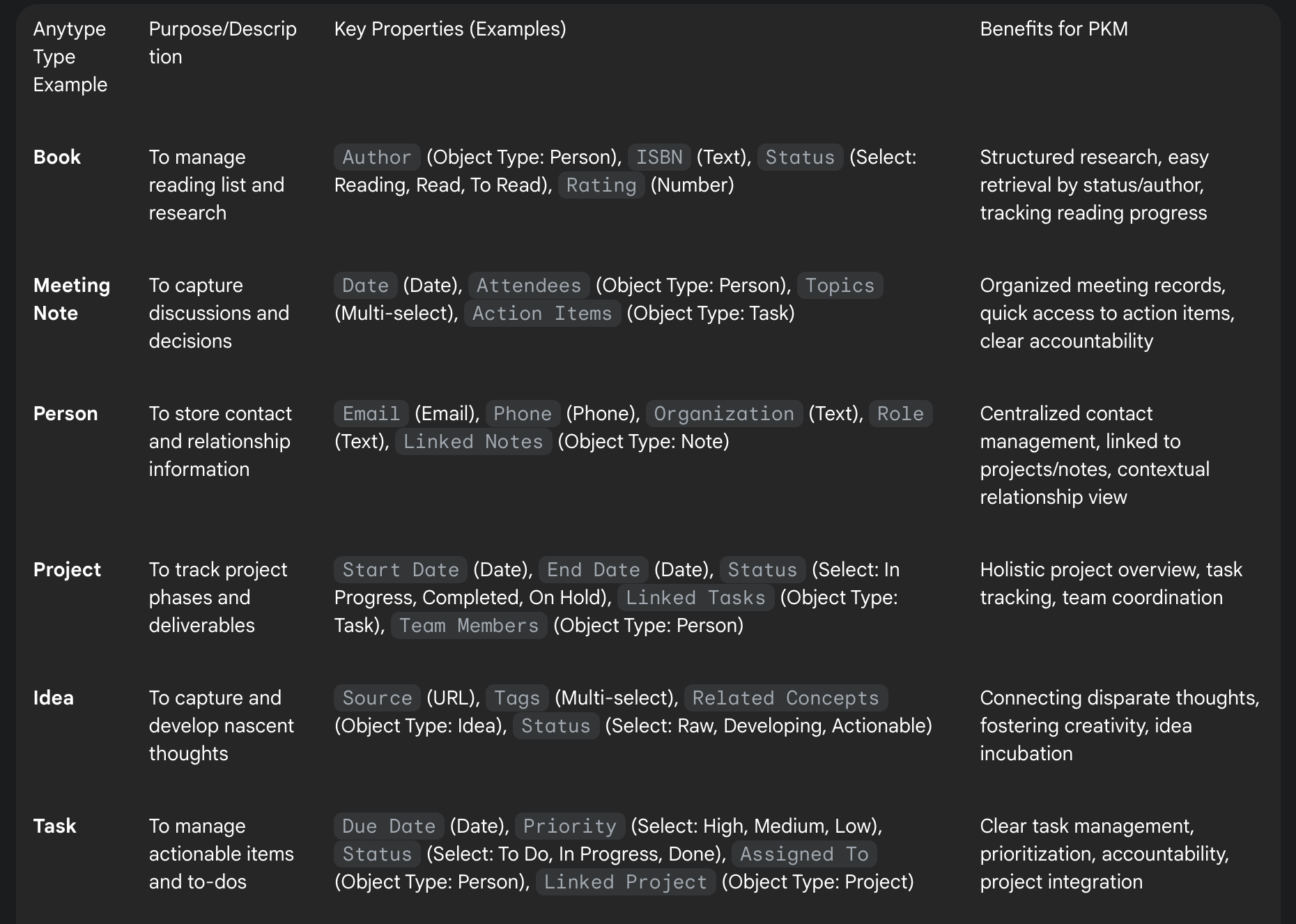
This table demonstrates how Anytype’s object-based approach, powered by user-defined “Types” and their “Properties,” provides a structured yet flexible framework for personal knowledge management. By explicitly defining the nature of each piece of information and its relationships, users can create a highly organized and interconnected “Second Brain” that supports efficient capture, retrieval, and synthesis of knowledge. The ability to link “Objects” of different “Types” through properties like “Object Type: Person” or “Object Type: Task” further illustrates the dynamic and interconnected nature of the system, enabling a rich, graph-like representation of personal knowledge.
The Collective Horizon — Towards a Digital Social Brain
The Social Brain Hypothesis and Collective Intelligence
The “Social Brain Hypothesis” posits that human intelligence evolved to solve complex social problems, and that the cognitive demands of sociality drove the evolution of human cognition.20 Humans are inherently social beings, dependent on cooperation for survival, and invest considerable effort in forming and maintaining social bonds.21 Beyond individual intellect, “collective intelligence” emerges from groups, influenced by factors such as social sensitivity and equitable conversational turn-taking.22 It encompasses how groups can switch between intuitive (Type 1) and rational (Type 2) reasoning to solve problems.20 Digital systems play a crucial role in enabling this collective intelligence, particularly through knowledge graphs that facilitate shared understanding and advanced analysis.17
Challenges of Centralized Collaboration
Traditional cloud-based collaboration platforms, while offering convenience, often involve storing data on central servers. This leads to significant concerns regarding data ownership, privacy, and potential access by third parties.3 Such reliance on a single company’s cloud infrastructure creates a fundamental tension with the desire for autonomy and trust.4 Furthermore, it can lead to vendor lock-in, limited control over one’s own data, and the risk of service interruption or censorship.4 These challenges underscore the need for alternative models that prioritize user sovereignty and data integrity in collaborative environments.
Anytype’s Decentralized Collaboration Architecture
Anytype addresses these challenges through a fundamentally different approach to collaboration. It utilizes a “peer-to-peer” (P2P) architecture for secure and decentralized synchronization. Data is synced directly between devices, often on local networks, without relying on a central server as a gatekeeper.4 This means that no intermediary mediates the connection between devices, fostering direct trust and autonomy.
Data is stored locally first and then synced to a backup node (or can be self-hosted) using a private IPFS network, which is a “Peer-To-Peer file system that facilitates decentralized data storage across devices”. Critically, all data is protected by “local, on-device encryption” and “zero-knowledge encryption,” ensuring that only the user (or explicitly invited collaborators) possesses the encryption keys.
Anytype allows users to create “Shared Spaces” for real-time collaboration with teams or communities. Within these spaces, the owner retains complete control of their keys, owns their social graph, and decides on hosting arrangements. Access roles, such as Editor or Viewer, can be managed via invite links, empowering user-controlled access 24 and promoting digital sovereignty.
Anytype’s decentralized architecture forms the foundation for trust in collective intelligence. Collective intelligence relies on participants contributing and sharing knowledge effectively. A fundamental barrier to open and robust collaboration, especially with sensitive information, is a lack of trust in the platform’s custodians. Centralized systems inherently require users to trust the company with their data.4 Anytype’s decentralized architecture, encompassing P2P, local-first storage, IPFS, and end-to-end encryption, removes the need for a central intermediary. Data is owned by the user, not a company’s cloud.3 This shift from trusting a third party to trusting the underlying cryptographic guarantees and verifiable open code 4 creates a higher-order trust model. This enhanced trust is critical for fostering genuine, uninhibited collaboration, particularly for sensitive or proprietary collective knowledge, making it a true “social brain” rather than just a shared document. This suggests a paradigm shift in collaborative software, where the underlying architecture is designed to minimize reliance on centralized trust, thereby unlocking new levels of secure and autonomous collective intelligence, especially relevant for Web3 and privacy-conscious organizations.
Anytype’s Decentralized Collaboration vs. Traditional Platforms
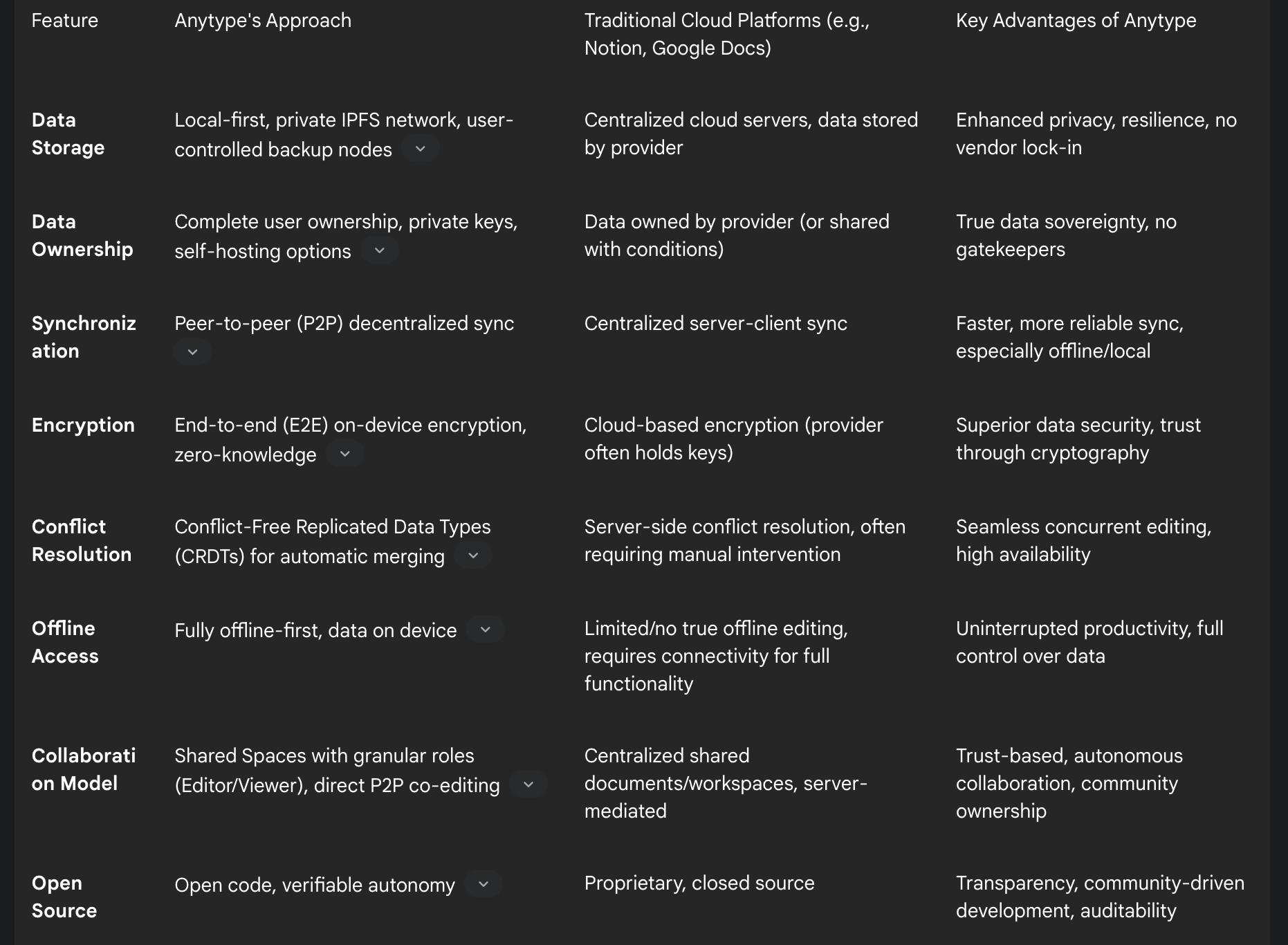
The table below provides a comparative overview of Anytype’s decentralized collaboration model against that of traditional cloud-based platforms, highlighting the distinct advantages offered by Anytype’s architectural choices.
This comparison underscores Anytype’s commitment to a decentralized, privacy-first approach to collaboration. By shifting away from centralized control, Anytype offers users a higher degree of data sovereignty and security, while maintaining robust co-editing capabilities. This architectural choice is fundamental to its vision of a “Social Brain” where collective intelligence can flourish on a foundation of trust and autonomy.
Synthesizing Intelligence — How “Types” Bridge Personal and Social Brains
Structured Collaboration
Anytype’s “types” and “properties” provide a standardized, yet customizable, framework for organizing information.11 In a collaborative context, this means that shared “Objects” (e.g., “Project,” “Meeting Note,” “Research Paper”) adhere to predefined structures, ensuring that all collaborators understand the data uniformly.17 This fosters a “shared understanding of data across different systems and datasets”.17 By structuring shared knowledge through “types,” teams can move beyond unstructured documents to a more organized and queryable collective intelligence. This allows for easier data integration, enhanced semantic search, and better insights.18 For instance, a “Team Wiki” 4 built on Anytype can leverage “Types” like “Team Member,” “Project,” and “Decision” to create a highly navigable and consistent knowledge base. The object-based model, combined with CRDTs, allows for seamless co-editing of structured data. Collaborators can contribute to shared “Tasks” (with “Status,” “Assigned To” properties), “Projects” (with “Start Date,” “Linked Tasks” properties), or “Knowledge Bases” (with “Topic,” “Source” properties).6 This ensures that collective efforts build upon a coherent and interconnected knowledge graph.
The “Types” function as the mechanism for bridging heterogeneous personal knowledge into coherent collective intelligence. The “Second Brain” is deeply personal and often unstructured initially.1 The “Social Brain” requires shared understanding and structured data.17 Anytype’s “types” allow flexible categorization and attribute definition.11 Individuals capture information in highly personal ways, often leading to fragmented or inconsistent data.1 When this personal knowledge is brought into a collective environment, a lack of shared structure can hinder effective collaboration and lead to information silos.17 Anytype’s object-based system, enforced by “Types,” provides a powerful solution. Even when an individual captures a “Note” (a Type), they can later refine it, add properties, or link it to other “Objects”.8 When this “Note” is shared into a collective “Space,” its inherent “Type” and “Properties” provide the necessary metadata and structure for it to be understood, queried, and integrated by others.17 Therefore, “Types” act as the semantic adapter that translates diverse, individually-captured knowledge into a coherent, machine-readable, and collaboratively usable format. This allows the “Social Brain” to aggregate and make sense of the heterogeneous “Second Brains” of its members, enabling true collective intelligence. This suggests that the future of collaborative knowledge management lies in systems that can impose flexible, user-defined structure at the point of creation, allowing for seamless integration and collective understanding across diverse individual contributions, moving beyond simple file sharing to true semantic collaboration.
From Individual Contributions to Collective Wisdom
The “Second Brain” thrives on individual capture and organization.1 Anytype’s design allows these personally curated “Objects” (e.g., a “Note” on a new concept, an “Idea” for a feature) to be seamlessly shared into a “Shared Space”.6 When shared, these individual “Objects” retain their “Type” and “Properties,” allowing them to integrate meaningfully into the collective “Social Brain.” The interconnectedness fostered by “types” and the graph view means that personal insights can cross-pollinate with collective knowledge. A personal “Thought” object, when shared, can link to a team’s “Project” object, enriching both.2 This dynamic flow enhances “collective intelligence” by allowing individual “slow burns” and “intermediate packets” 1 to contribute to a larger, shared pool of knowledge.
The structured nature of data within Anytype, defined by its type system, makes it inherently compatible with advanced analytical tools, including Artificial Intelligence (AI) and Machine Learning (ML).19 This means that as collective knowledge grows and becomes more structured, it can serve as a foundation for future AI-driven insights, summaries, or recommendations within the “Social Brain”.3
Governance and Community
Anytype’s long-term vision extends beyond a mere application; it aims to build a “digitally sovereign collective” and a “web of love and harmony”.25 This involves promoting “digital freedoms: freedom of thought and expression, freedom to connect with those whom we trust, and freedom to participate in the governance of our digital creations”.29 The platform is open-source and envisions a “community-owned ecosystem”.5 Future plans include a “token economy” and a “reputation & karma” system to incentivize user contributions (code, documentation, content) and participation in network governance.29 This ensures that the “Social Brain” evolves based on the needs and feedback of its community, rather than a centralized entity.35
Anytype’s governance model is a direct reflection of its “Social Brain” philosophy. The “Social Brain” concept implies a collective entity that learns, adapts, and makes decisions.20 For a digital “Social Brain” to truly embody autonomy and trust, its governance cannot be centralized in a single corporate entity, as this would contradict the core philosophy of user sovereignty.4 Anytype’s proposed governance model, with unique decentralized names, community ownership, and reputation-based influence 29, directly mirrors the decentralized and autonomous nature of its technical architecture. This creates a feedback loop where the community that builds and uses the “Social Brain” also governs its evolution, ensuring alignment with user values such as privacy and ownership, and fostering a sense of shared responsibility.35 Therefore, Anytype’s governance model is not merely a business strategy; it is a philosophical and practical extension of its “Social Brain” vision, aiming to create a self-sustaining, self-governing collective intelligence that is truly owned by its participants. This points to an emerging trend in decentralized applications where the governance structure becomes as critical as the technical architecture in realizing the promise of user sovereignty and collective agency, moving towards truly democratic digital ecosystems.
The Future of Knowledge with Anytype
Anytype stands at the vanguard of knowledge management, offering a compelling bridge from individual “Second Brain” mastery to collaborative “Social Brain” intelligence. Its local-first, decentralized architecture, underpinned by robust encryption and Conflict-Free Replicated Data Types (CRDTs), addresses critical concerns around privacy, data ownership, and resilience. The core “type” system provides the structured flexibility necessary for both personal organization and coherent collective understanding, acting as the semantic backbone for its evolving knowledge graph.
For individuals, Anytype provides an unparalleled environment for personal knowledge management, fostering creativity and deep thinking through its flexible object model and intuitive graph view. The seamless synchronization and offline capabilities ensure that one’s “Second Brain” is always accessible and responsive, enhancing personal productivity and intellectual development.
For organizations and communities, Anytype offers a secure, trust-based platform for collective intelligence. Its decentralized collaboration features, powered by CRDTs, enable seamless co-creation and shared understanding without compromising data sovereignty. This fosters a collaborative environment where diverse individual contributions can coalesce into a coherent and actionable “Social Brain,” promoting genuine collective wisdom.
To fully leverage Anytype’s potential, several recommendations are pertinent:
- Embrace the Object Model: Users should invest time in understanding and customizing “Types” and “Properties” to truly unlock Anytype’s structured flexibility, moving beyond traditional folder-based thinking. This deeper engagement allows for the creation of highly tailored and interconnected knowledge systems.
- Explore Collaborative Spaces: Organizations should experiment with Shared Spaces to experience decentralized co-editing. Recognizing the unique advantages this offers for secure and autonomous teamwork can transform collaborative workflows, particularly for sensitive projects or distributed teams.
- Engage with the Community: As an open-source and community-driven project, active participation in Anytype’s ecosystem can significantly shape its future development. Contributing to the community and participating in its evolving governance model can help realize the vision of a “digitally sovereign collective.”
Anytype represents a significant step towards a future where digital tools not only augment individual cognition but also empower secure, decentralized collective intelligence, fostering a new era of collaborative knowledge creation that prioritizes user autonomy and trust.
