Nope.
The root thing is a Collection.
In most cases (and good for thousands Objects), the structure is as simple as this:
Main Collection (View 1)
                         --> Set 1 (View 1)
                                            --> Object 1
                                            --> Object 2
                                            --> Object ...
                         --> Set 1 (View 2)
                                            --> Object 15
                                            --> Object 16
                                            --> Object ...
                         --> Set 1 (View 3)
                                            --> Object 36
                                            --> Object 37
                                            --> Object ...

                         --> Set 2 (View 1)
                                            --> Object 150
                                            --> Object 151
                                            --> Object ...
                         --> Set 2 (View 2)
                                            --> Object 300
                                            --> Object 25
                                            --> Object ...
                         --> Set 2 (View 3)
                                            --> Object 36
                                            --> Object 1
                                            --> Object ...
And so on.
In this example, the main Collection shows here only one View, but of course there are more. Maybe 12 or so.
In each View are about 10-20 Sets to see. Let's say, in average 15. That means: 12*15=180 Sets.
And each of these Sets has maybe  10 Views.
That means: 180 Sets * 10 views = 1800 Views!
Wrong, my second level contains only Sets.
The root is a Collection, the second level are a lot Sets
But in principle, it’s a good question, I was thinking a lot about this before and while making this structure.
Weighing up the pros and cons, I came to the conclusion, that a Collection would do the best job as the root “thing”.
– One of the reasons for this decision already no longer exist, after rebuilding everything. But I still think that it makes most sense.
It would be a lot writing to explain it; in principle is everything possible, but each way has it’s own advantages and disadvantages.
It also depends from your old way to organize things. I highly relay on Tags. And I use Sets for gathering Objects from everywhere, based mostly only on their Tags.
I could use a Set also for the first level, instead of a Collection, yes.
But there’s a lot to speak about it.
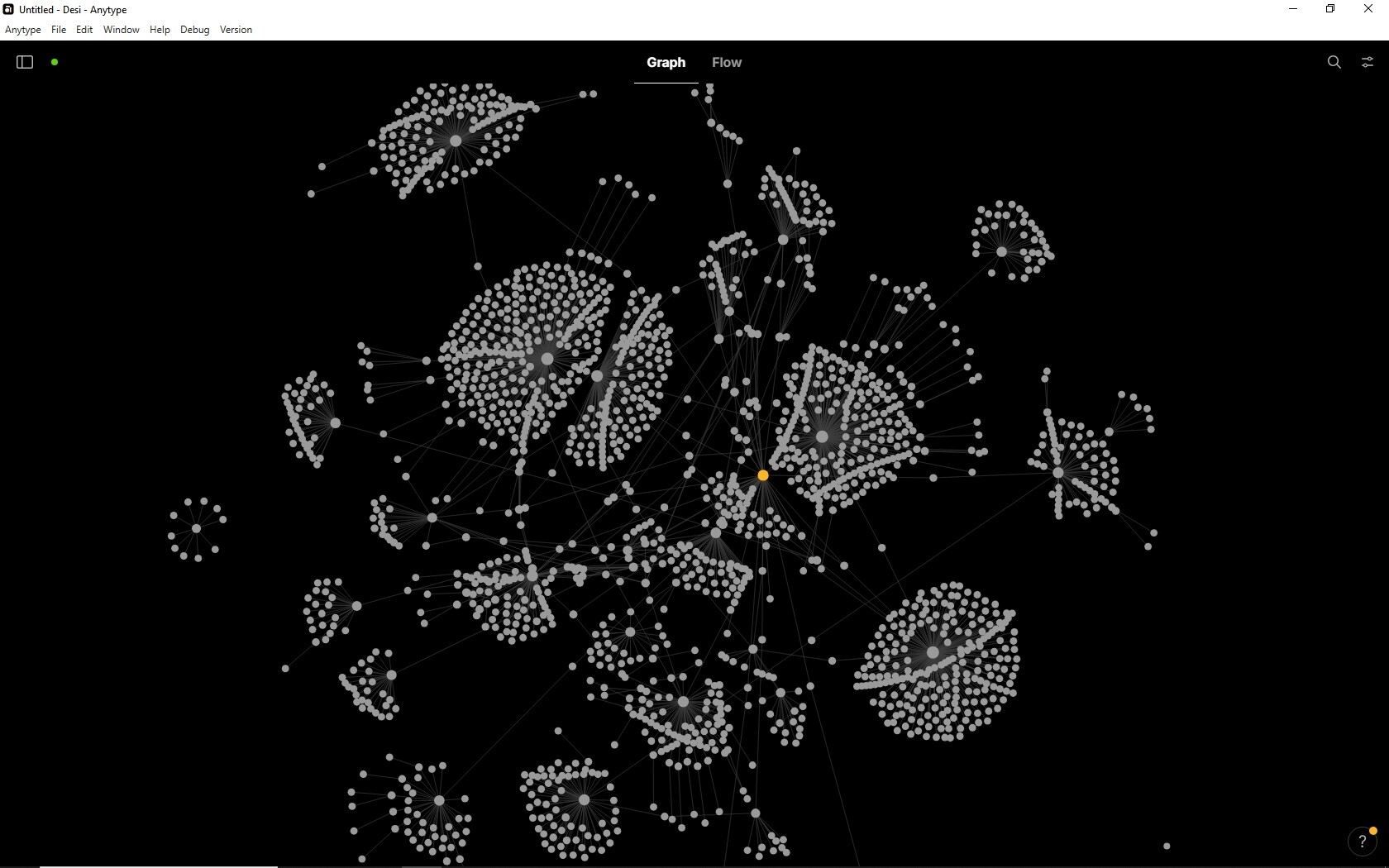
One point is, that my main Collection now is the most central point in the Graph.
It leads to the many Sets in it.
These Sets then, are connected to Collections, that contain Objects.
Deviating from my post in the other thread, my new Graph looks so:
It has a much better structure now and my rebuilding process is still in progress.
But to have a Collection as first level has theoretically also the advantage, that I simply need to put the second level Sets in it, without the need to tag them in a specific way so that a first level Set could deal with them.
– In practice it differs again – indeed there was need to tag the second level Sets …
But spare me to tell the whole story.
There are workaround for different limitations here and there that make it hard to explain.
At the moment I suffer from the fact that Objects, if new created from inside a Set, become floaters in the Graph. I’ve already requested a feature for that, some days ago.
At the moment, I need to connect each new Object by hand with a target Collection. This is a disadvantage, compared with my old way to organize things.
The new “List” will end this little suffering and some others, I think.

 My bad. I only use Sets from the begining for all the reasons already mentionned by others.