Yes, both sides are 100% useful. But what I meant was changes to a type should be more explicit than just adding something to one object. If I change an object, I only expect that object to change. If I change a type on a type page, only then do I expect all the objects of that type to change.
So, for me personally, the intuitive thing is that it should not be default that changes to one object change all other objects, but rather that you explicitly say this is what you want to do within the program, for example, a new button/option saying “Add New Relation to Type” - this can even be placed within the current Type menu thing here:
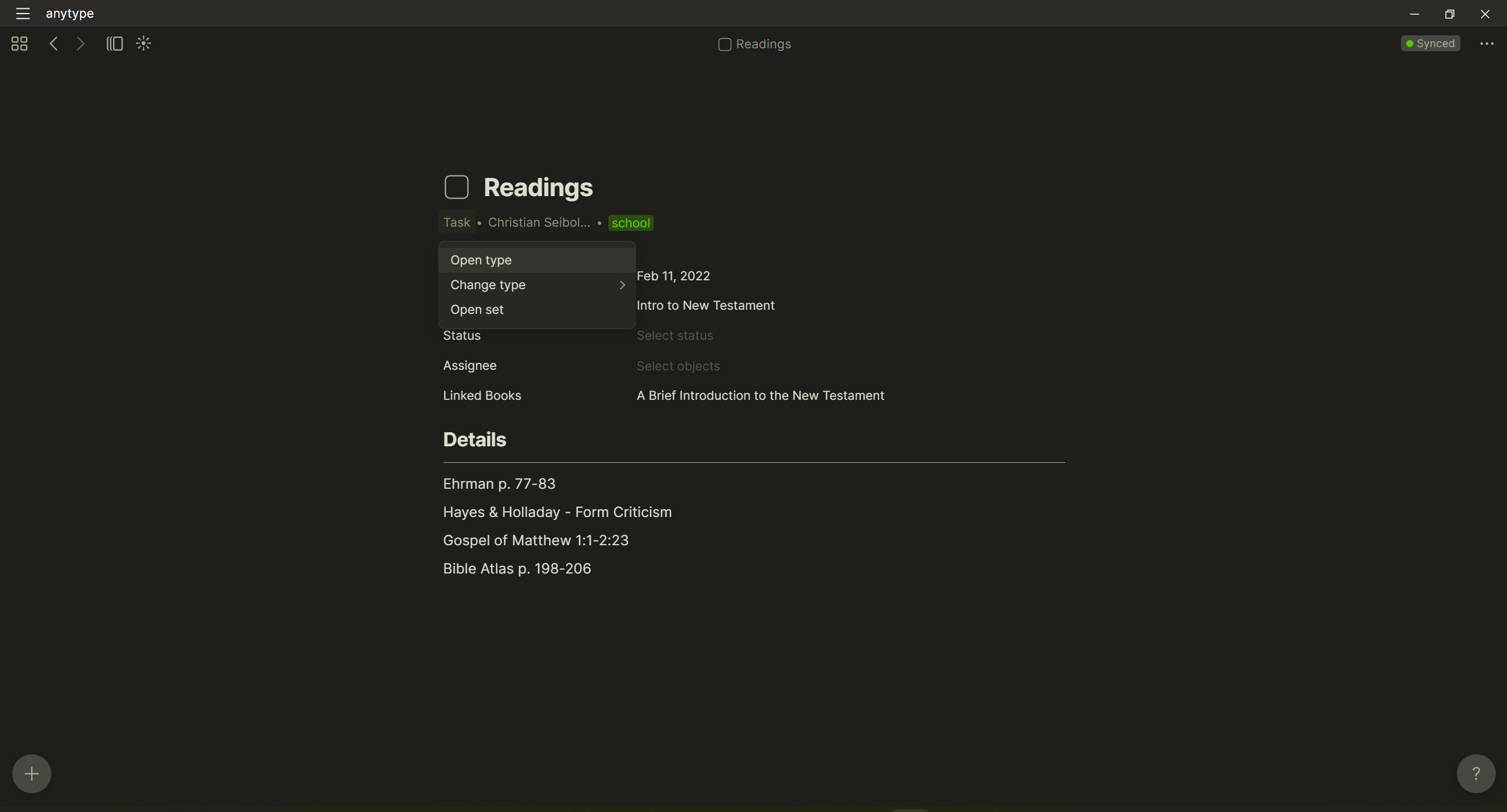
I misunderstood, my bad. You are totally right, it makes total sense Indeed.
It’s fine 
Honestly, if this whole conversation were talking about a programming language, I would be making the exact opposite argument than what I’m making right now. But because this is a note-taking and information storage (knowledge base) thing, I just feel like the more intuitive approach is the one that is not like most programming languages (that have strict typing) and more like real life, with fluid typing (a balance between strict and dynamic typing and prototyping) and fluid properties.
I might be wrong here, I got a bit lost on all the comments, but I think that quote resumes what @nesdroc meant from the start in regard to that topic…
Though I agree he is trying to make multiple points in one post, so that might the confusing part.
About this, the problem IMO is that we can’t (at the very least) add relations to default types (I haven’t found a way). I understand it’s more complicated to implement the ability to remove or modify default relations, but it may force people to create new types that are basically copies of the default ones, just to have more control.
About this, the problem IMO is that we can’t (at the very least) add relations to default types (I haven’t found a way). I understand it’s more complicated to implement the ability to remove or modify default relations, but it may force people to create new types that are basically copies of the default ones, just to have more control.
I agree - the ability to modify (or at least add relations to) default types would be useful, even with the workaround I provided early in the conversation. I’m not sure if this has already been a requested feature.
This will be addressed in the next big releases with new primitives project. ETA is Feb-Mar